日本語
日本語  Deutsch
  English
  Español
  Français
  Português


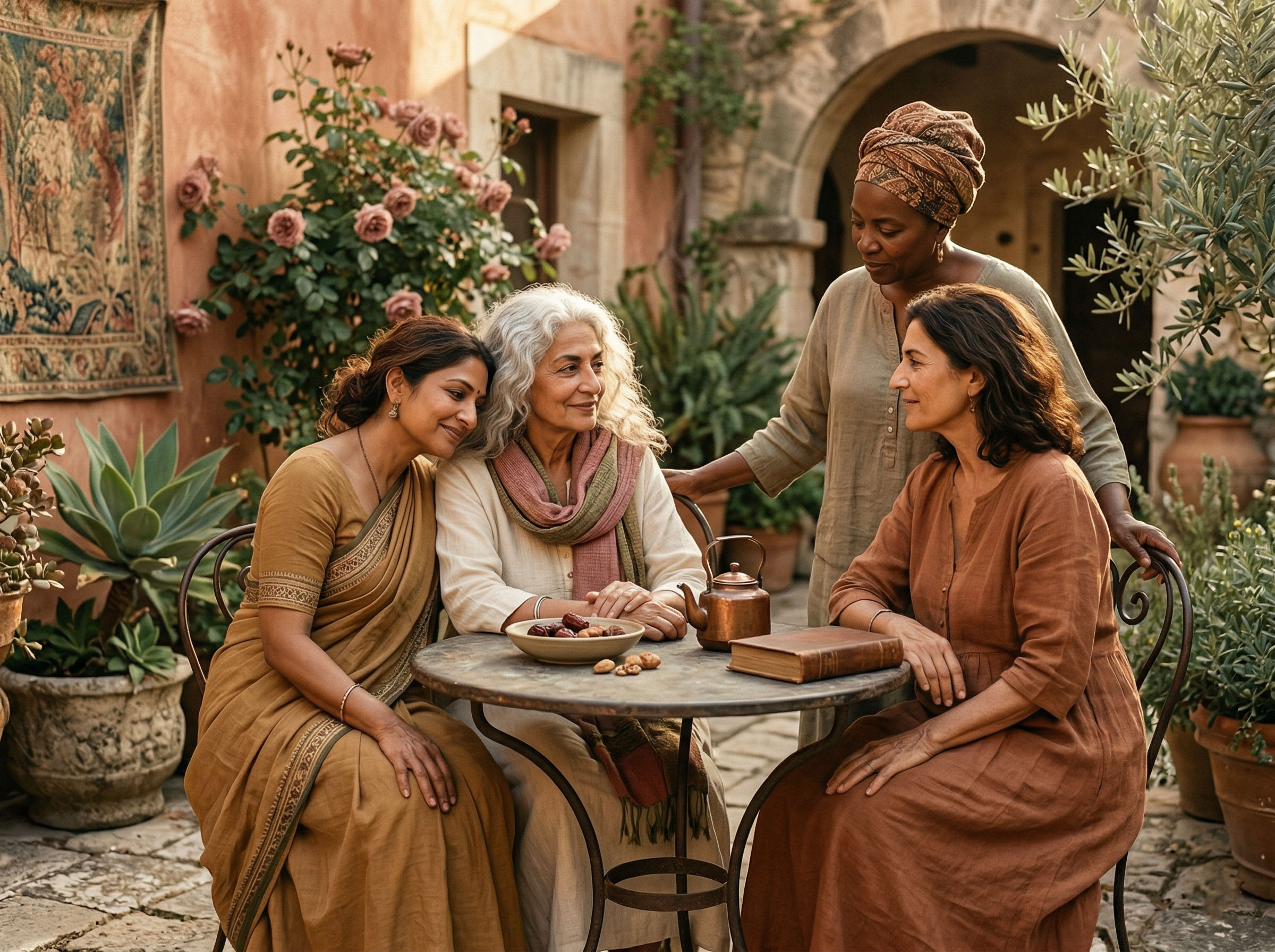
There is a moment — and most women who have crossed it can describe it with uncanny precision — when the body begins to speak a different language. The rhythm that defined the past three or four decades quietly shifts.
The cycles slow, the temperature regulation falters, sleep becomes an unreliable companion, and something in the mirror starts to look both familiar and new at once. In the Western world, this moment is often met with a kind of collective flinch. We hand it a clinical name, load it with pharmaceutical considerations, and move swiftly past any deeper conversation.
But step outside Western medicine's framing for just a moment, and you will find something remarkable: women around the world have been living through this transition for millennia, and many of them — guided by culture, tradition, community, and hard-won female wisdom — have found ways not merely to endure it, but to greet it with something approaching welcome.
This is not a call to abandon modern medicine. It is an invitation to look at what different cultures have preserved about female midlife that we, in our urgency to fix and suppress, may have quietly discarded.
"Women around the world have been living through this transition for millennia — and many of them have found ways not merely to endure it, but to greet it with something approaching welcome."
— Amara LeclercJapan: The Woman Who No Longer Bows to the Clock
Perhaps no culture offers a more striking contrast to the Western experience of menopause than Japan. Japanese women report some of the lowest rates of hot flashes and disruptive menopausal symptoms in the world — a fact that has fascinated researchers for decades. While diet (particularly the consumption of soy isoflavones, which act as plant-based estrogens) plays a documented role, the cultural and linguistic framing of midlife may matter just as much.
In Japan, the transition is known as konenki — a word that translates roughly as "renewal years" or "years of energy change." The term carries none of the finality that the English word "menopause" implies. Where English speakers end things (meno = month, pause = stop), the Japanese language describes transformation. Konenki is understood as a long, gradual process of physical recalibration — not a cliff's edge.
Japanese women experiencing midlife are not described as "going through menopause" in casual speech — they are said to be in their konenki, their renewal years. Culturally, this period has historically been associated with a woman gaining authority within the household and community — not losing relevance. Older women in traditional Japanese households often move from the role of caregiver to that of matriarch and keeper of family knowledge.
Japanese society has also traditionally ascribed greater social authority to older women. In many family structures, the older woman becomes the household's central decision-maker — a role that carries real weight and genuine respect. While modern Japan is rapidly changing and urban women face pressures quite different from their grandmothers, this underlying cultural scaffolding shapes expectations in ways that are difficult to fully quantify but impossible to ignore.
Researchers have also noted that Japanese women more commonly report symptoms like stiff shoulders and fatigue during midlife — conditions that carry no social stigma — while hot flashes, which Western culture has made almost synonymous with menopause, are reported far less frequently. Whether this is primarily physiological, psychological, or both remains a genuine scientific question. But the cultural permission to experience midlife without shame almost certainly plays a role.
India: When Status Finally Arrives
In many parts of India — particularly in rural and traditionally structured communities — menopause is not a loss but an arrival. For women in communities where menstruation carries significant ritual restrictions (limitations on entering the kitchen, the temple, or participating in certain family events), the end of those cycles represents the lifting of a long-standing constraint.
Research conducted among women in South India found that many reported menopause as a relief — an uncomplicated sense of freedom from the practical and social burdens of monthly cycles. Hot flashes were common, but they were not described as shameful or destabilizing. They were simply part of a passage that was understood, expected, and in many respects, celebrated.
The joint family system, still common in many parts of India, means that midlife women rarely face this transition in isolation. There are mothers-in-law, sisters-in-law, and neighbours who have walked the same road. There is a shared vocabulary for it — and with that vocabulary, a kind of normalisation that the isolated nuclear family structure of much of the West cannot easily replicate.
Menopause research is surprisingly recent.
The word "menopause" was coined by a French physician, Charles de Gardanne, only in 1821. For most of human history, the experience of female midlife was named and understood through cultural, religious, and community frameworks — not medical ones. Many of those frameworks treated the transition as a threshold into authority rather than a medical condition to be managed.
Indigenous Traditions: The Third Phase Woman
Among many Indigenous cultures of North America, a woman who had passed through menopause entered what was recognised as a distinctly new phase of life — one carrying its own title and its own responsibilities. In certain traditions, post-menopausal women were considered to have "kept their blood within" — and that retained life force was thought to make them powerful advisors, healers, and keepers of community knowledge.
The elder woman was not invisible. She sat at the centre of decision-making in many tribal councils. She was the one called upon when serious matters needed counsel, when births needed attending, when the dying needed to be guided. Her body's change was understood as preparation for that role — a graduation rather than a decline.
This framing stands in stark contrast to the way Western culture has often treated the post-reproductive woman: as someone who has completed her primary function. The Indigenous understanding inverts that entirely. The "Third Phase Woman," as some traditions called her, was considered to be entering her most socially important years.
The Physical Changes No One Discusses Enough
As estrogen levels decline during and after menopause, changes in vaginal tissue are among the most common yet least talked-about experiences women face. The medical term is genitourinary syndrome of menopause (GSM) — previously called vaginal atrophy. Tissues may become thinner, dryer, and less elastic, which can affect daily comfort and intimacy. This is a physiological reality experienced by a significant proportion of women, not a personal failing. Many cultures addressed this quietly, through community knowledge passed between women — botanical remedies, oils, and dietary practices handed mother to daughter. Across every culture examined in this article, older women served as the primary source of this intimate knowledge. Always consult a healthcare provider for personal guidance on managing these changes.
China: Harmony Over Hierarchy
Traditional Chinese medicine (TCM) has approached female midlife not as a deficiency state but as an imbalance requiring restoration of harmony. In TCM, menopause is understood within the framework of jing (essence) and kidney energy — the idea being that the body is redirecting, not depleting, its vital resources. Herbs like dong quai, black cohosh (used in related traditions), and prepared rehmannia have been used for centuries to support women through this transition.
What is notable here is the absence of alarm. TCM does not treat menopausal symptoms as pathologies to be eradicated — it treats the whole woman as a system seeking equilibrium. The role of the practitioner is not to restore a previous state but to support the body's movement toward its next natural phase.
Chinese culture has also historically held older women in significant social regard within family structures. The nǎi nai (paternal grandmother) and wài pó (maternal grandmother) are deeply respected figures — the emotional and practical anchors of extended families. Midlife does not signal diminishment in this frame; it signals the beginning of the years in which a woman's accumulated knowledge becomes the family's most valued resource.
Global Perspective
How Different Cultures Frame Female Midlife
| Culture / Region | Local Term or Concept | Dominant Cultural Framing | Social Role Shift |
|---|---|---|---|
| Japan | Konenki (renewal years) | Gradual transformation; energy shift | Gains household authority |
| India (traditional) | Passage out of restriction | Relief; freedom from ritual limits | Expanded access; matriarch-in-waiting |
| Indigenous North America | "Third Phase Woman" | Wisdom keeper; spiritual authority | Council advisor, community healer |
| China (TCM tradition) | Jing redirection; kidney harmony | Systemic rebalancing, not deficiency | Family matriarch; respected elder |
| West Africa (Yoruba) | Ìyá — Great Mother | Peak feminine power; communal anchor | Spiritual and civic leadership |
| Western (contemporary) | "Menopause" (medical) | Deficiency; symptoms to manage | Often undefined or diminished |
West Africa: The Great Mother Who Has Arrived
Among the Yoruba people of West Africa, the concept of the Ìyá — the Great Mother — is one of the most powerful social designations a woman can hold. It is not conferred at birth or marriage. It is earned through age, through survival, through the full arc of a woman's life. Post-menopausal women in Yoruba tradition are understood to have moved into their most formidable social position.
In many West African traditions more broadly, older women serve as the guardians of communal memory: the keepers of oral history, the mediators in disputes, the ones who prepare younger women for the rites of womanhood. Their bodies are not seen as past their prime — they are seen as having finally arrived at their prime.
This is not romanticisation. Life in traditional West African communities carries immense hardship, and women's lives have never been without difficulty. But within that hardship, the cultural architecture around female aging built something that the West often lacks: a clear, honoured social role waiting on the other side of menopause.
"The cultural architecture around female aging built something the West often lacks: a clear, honoured social role waiting on the other side of menopause."
— Amara LeclercThe Mediterranean: Age as a Kind of Beauty
In traditional Greek and broader Mediterranean culture, the older woman — η γυναίκα in her fullness — has long been a figure of authority and presence rather than absence. The grandmother who rules the kitchen, manages the extended family's emotional life, and whose opinion carries weight at the table: this is an archetype with deep roots.
Research comparing Greek and American women's experiences of menopause found that Greek women reported significantly fewer symptoms and less distress — a finding that held even when researchers controlled for lifestyle factors. Cultural expectation, it turned out, was doing some of the heaviest lifting. Women who expected midlife to bring status were more likely to experience it that way.
The Mediterranean diet — rich in olive oil, legumes, whole grains, and fish — is frequently cited in health research as supportive of hormonal balance and cardiovascular health during menopause. But diet alone cannot account for the difference. The social environment in which a woman experiences her body matters profoundly.
Menopause Around the World — At a Glance
What We Can Take From All of This
Reading across these traditions, a few threads emerge with remarkable consistency. First: the cultures in which women experience midlife most smoothly tend to be those in which older women hold genuine social value. The symptoms of menopause do not disappear, but they are absorbed differently when the woman experiencing them is moving toward something — a role, a recognition, a new kind of authority — rather than away from something.
Second: community matters enormously. The isolation of the modern Western woman during this transition — living in a nuclear family, often without close contact with other women who have been through it — is historically unusual. For most of human history, women went through this surrounded by other women who had walked the same road and had practical, intimate knowledge to share. That loss of community knowledge has real consequences.
Third: the physical changes of menopause — the hot flashes, the sleep disruption, the shifts in skin and tissue — are universal. But how a woman understands those changes, what meaning her culture attaches to them, and what awaits her on the other side are not universal at all. They are shaped, more than we often acknowledge, by the stories women are told about what their bodies are doing and why.
Common Questions Women Ask About Midlife & Menopause
The Knowledge Was Always There
Every culture examined here — Japan, India, West Africa, Indigenous North America, China, the Mediterranean — developed over centuries a body of knowledge about what happens to women in midlife. That knowledge was not written down in journals or catalogued in databases. It was passed, one woman to the next, through conversation, ceremony, and shared experience. It was embedded in language, in social roles, in the herbs kept in the kitchen and the rituals observed at transitions.
Much of that knowledge has frayed. Modernisation, migration, and the medicalisation of natural life processes have broken many of those chains of transmission. Western women, in particular, often arrive at perimenopause with almost no preparation — and find themselves navigating a transition that their great-grandmothers would have understood as one of life's most significant and, in the right context, most freeing passages.
The knowledge is not gone. It is recoverable — in the scholarship of anthropologists and medical researchers, in the living traditions of cultures that have not yet abandoned these frameworks, and in the conversations that women begin to have with each other when they decide, together, that this transition deserves more than a clinical name and a prescription.
What the world knows about midlife that we have sometimes forgotten is this: a woman who has passed through the fire of her reproductive years, who has carried children or not, who has built a home and a life and a self, is not diminishing. She is arriving. And across most of human history, the world knew to treat her arrival as something worth celebrating.
What This Article Covers
- Japan's konenki — why "renewal years" changes everything about how midlife is experienced
- How traditional Indian culture frames menopause as liberation rather than loss
- The "Third Phase Woman" in Indigenous North American traditions — the peak of social power
- Traditional Chinese medicine's approach to midlife as systemic rebalancing, not deficiency
- West African traditions placing post-menopausal women at the centre of communal life
- Why Mediterranean women report fewer symptoms — and what diet and culture each contribute
- The physical changes most women aren't warned about — and why community knowledge matters
- What we can reclaim from these traditions in a modern context
Disclaimer: This content is for informational and educational purposes only and does not constitute medical advice. It is not intended to be a substitute for professional diagnosis or treatment. Always consult with a qualified healthcare provider regarding any medical condition or treatment plan. Never disregard professional medical advice because of something you have read here.