日本語
日本語  Deutsch
  English
  Español
  Français
  Português



For centuries, the female body has been treated as a Great Unknown—a territory mapped by explorers who often lacked the right compass. When we look at the history of anatomy, specifically the vulva and vagina, we aren’t just looking at a timeline of biological discoveries.
We are looking at a mirror of the eras that produced them. From the "inverted" theories of the Renaissance to the Victorian "vapors," the story of how women were understood is a winding road of misconceptions, cultural biases, and, eventually, a return to the foundational truths of biological reality.
To understand where we are today, we must look back at the curious, often bizarre ways the female form was interpreted by the leading minds of the past. It is a journey that reveals as much about the men who studied it as the women who lived it.
The "Inverted" Theory: When Women Were Interior Men
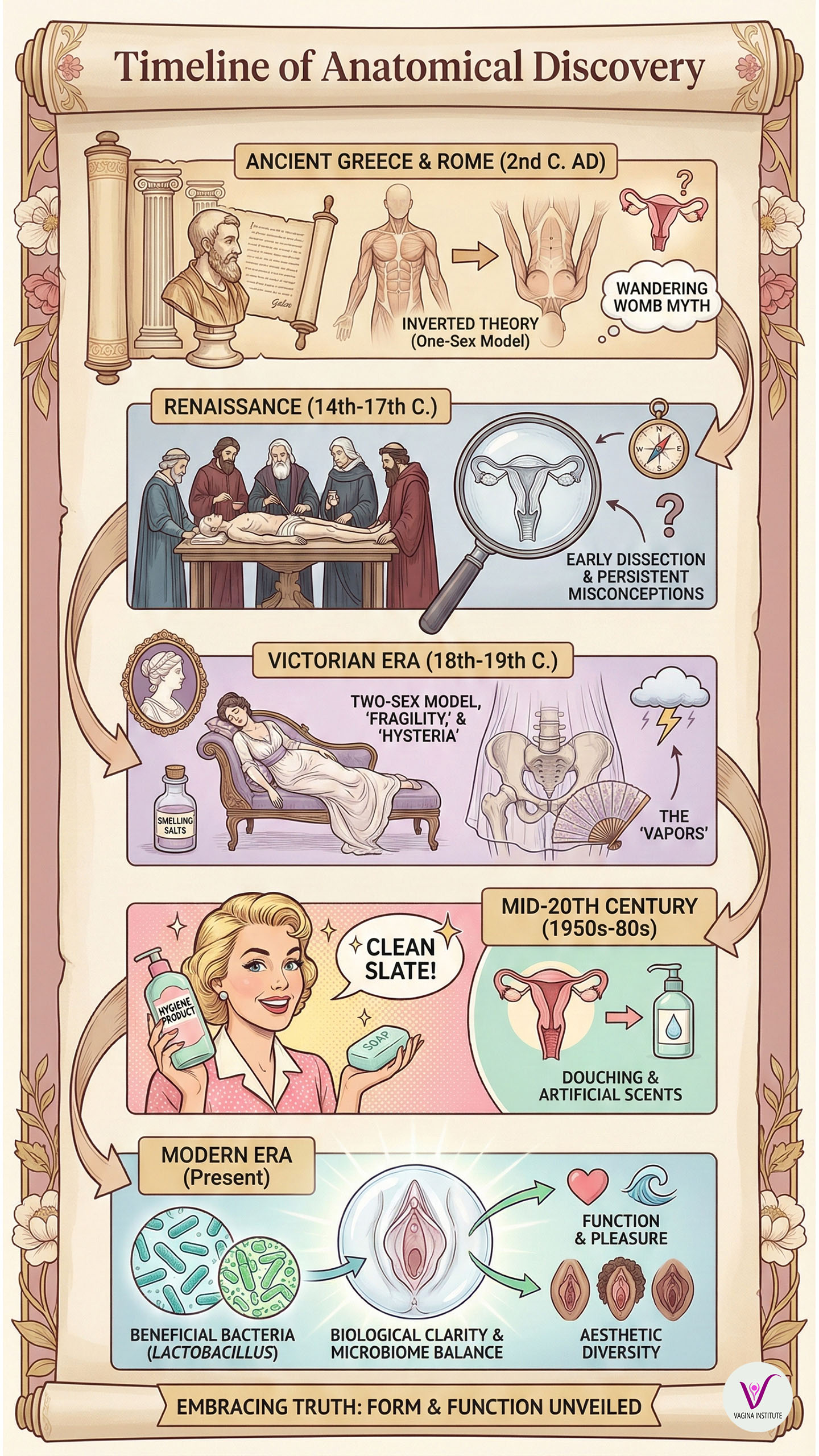
In the classical world, particularly under the influence of the Greek physician Galen in the second century AD, the prevailing belief was that women were essentially "inverted" men. This wasn't a metaphorical observation; it was a literal anatomical conviction. Galen posited that women possessed the same reproductive organs as men, but because women were supposedly "colder" and less "perfected" by nature’s heat, their organs remained internal.
In this worldview, the vagina was viewed as an internal penis, and the ovaries were simply internal testicles. The biological distinction we recognize today—the unique, specialized architecture of the female reproductive system—was seen as a failure of development rather than a distinct, complementary design. This "One-Sex" model dominated Western thought for over a millennium.
The implications of this were profound. It framed femininity as a derivative of masculinity, an "incomplete" version of the male standard. Yet, interestingly, this era didn't lack a sense of the importance of women. In traditional societies, the role of the mother and the keeper of the hearth was paramount. The misunderstanding was purely physical, born of a lack of dissection and a philosophical urge to see the world through a single, hierarchical lens.
The Wandering Womb and the Origins of "Hysteria"
Perhaps no historical myth has been more persistent than that of the "wandering womb." Ancient Egyptian and Greek texts suggested that the uterus was a living creature with a mind of its own. It was believed that if a woman remained unmarried or "unfulfilled" in her traditional role, her womb would become dry and light, detached from its moorings, and travel throughout the body in search of moisture.
If the womb migrated to the heart, it caused anxiety; if it moved to the head, it caused lethargy or headaches. This was the birth of "hysteria"—a word derived from hystera, the Greek word for uterus. For centuries, the solution to almost any female ailment was simple: marriage and motherhood. While we now know the uterus is firmly held in place by a complex network of ligaments, the cultural weight of this myth persisted well into the 19th century.
It is worth noting that while the "wandering womb" was a biological fallacy, it underscored a traditional truth: the deep connection between a woman’s reproductive health and her overall well-being. Modern science confirms that hormonal cycles influence everything from bone density to neurological health. The ancients were wrong about the mechanics, but they were right about the significance of the female reproductive system as a central pillar of a woman’s life.
The Victorian Veil: Aesthetics and Silence
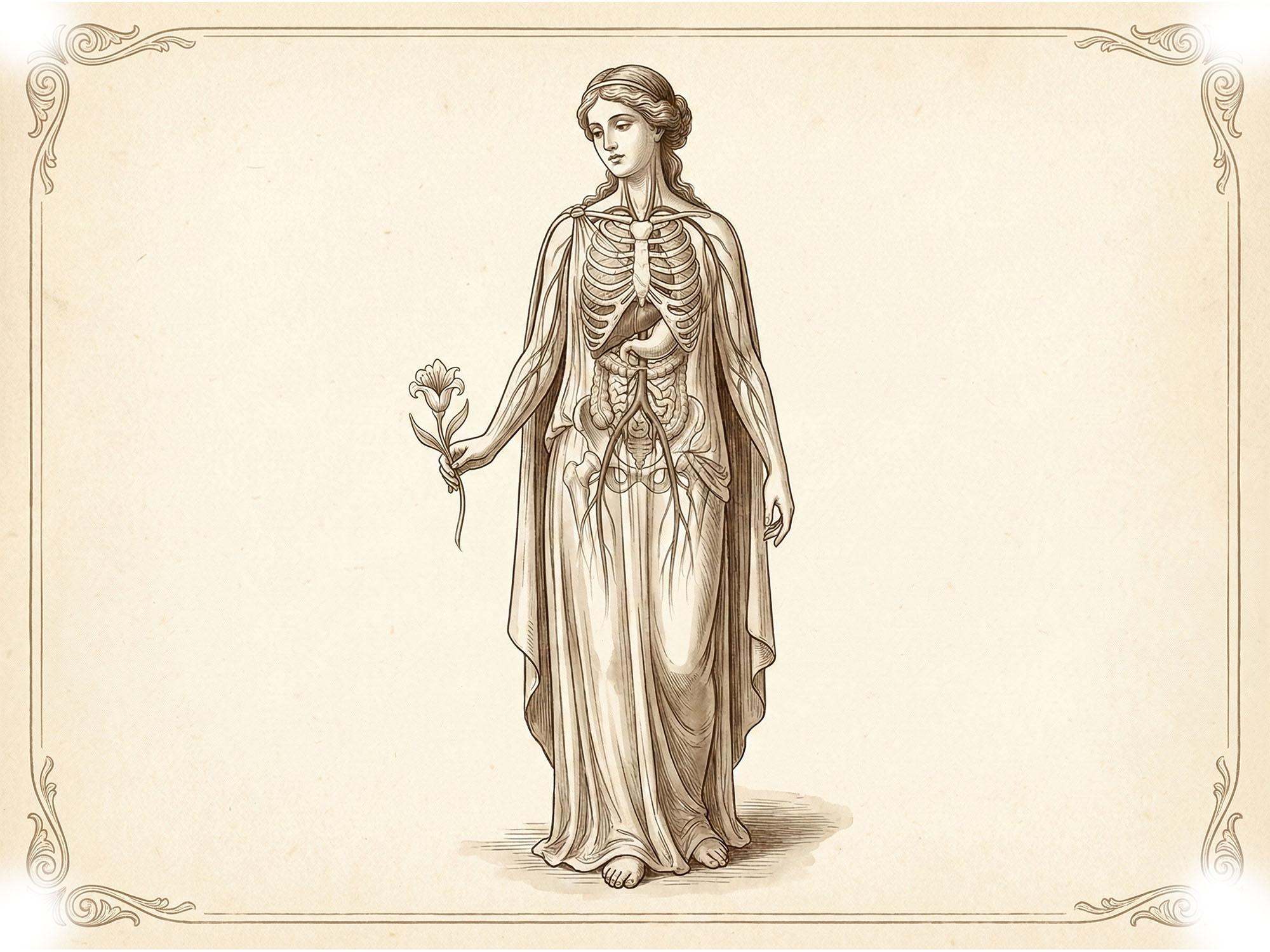
As we moved into the 18th and 19th centuries, the "One-Sex" model faded, replaced by the "Two-Sex" model. Science finally began to recognize that men and women were biologically distinct categories—different in every cell, not just in the placement of their organs. This was a leap forward in accuracy, but it came with a new set of cultural baggage.
The Victorian era introduced a profound sense of modesty that often bordered on anatomical erasure. While the Enlightenment had brought rigorous study to the male form, the female form was often shrouded in euphemism. The vulva was rarely discussed in polite society, and even medical textbooks sometimes skipped detailed illustrations of female genitalia to avoid "offending" the reader.
"The biological functions of the female body—from menstruation to the natural changes of the vaginal microbiome—are signs of a healthy, functioning system, not a mystery to be solved."
This silence birthed a new set of misconceptions. Because the vagina was hidden, it was often viewed through a lens of "fragility." Women were encouraged to avoid strenuous exercise or intellectual overexertion, lest it "damage" their reproductive capacities. It was a time when the aesthetic of the "fainting lady" reigned supreme—a stark contrast to the robust, hardworking women who had populated history for ages.
Yet, even in this era of repression, the traditional roles of men and women were clearly defined. Men were the protectors and providers, and women were the nurturers. This social structure provided a stable foundation for the family, even if the medical understanding of the female body was lagging behind. The man’s role was to honor and protect the "fairer sex," a sentiment that, while perhaps overly sentimentalized then, rooted itself in a genuine respect for the distinct nature of women.
The Myth of the "Clean Slate"
One of the more modern misconceptions—one that we are only recently correcting—is the idea that the vaginal environment is a "blank space" that needs constant intervention. Throughout the mid-20th century, a surge in hygiene products suggested that the natural state of the vulva and vagina was somehow "unclean" or in need of artificial scenting.
This was a significant departure from the wisdom of our grandmothers, who understood that the body has its own natural balance. We now know that the vagina is a self-cleaning marvel, maintained by a delicate ecosystem of beneficial bacteria, primarily Lactobacillus. The historical push toward douching and harsh soaps was not based on biology, but on a commercialized version of femininity that prioritized an artificial aesthetic over actual health.
Did You Know?
The term "pudendum," historically used to describe the vulva, comes from the Latin pudere, which means "to be ashamed." Modern anatomical terminology has thankfully moved away from this cultural bias, focusing instead on biological accuracy and the inherent health of the female form.
The reality is that femininity is not something that needs to be "corrected" or "masked." The biological functions of the female body—from menstruation to the natural changes of the vaginal microbiome—are signs of a healthy, functioning system.
The Marriage of Form and Function
When we discuss the aesthetics of the female body, we must acknowledge the inherent beauty of its design. The vulva and vagina are not just "reproductive parts"; they are the gateway to life itself. In the modern era, there has been a rise in "cosmetic" concerns regarding the appearance of the labia, often fueled by unrealistic portrayals in media.
History teaches us that "normal" has always been a broad category. Historical anatomical sketches, when they were accurate, showed a wide variety of shapes and sizes. The modern obsession with a singular, "tucked-in" aesthetic is a relatively new phenomenon, often ignoring the fact that the female body is built for function—for pleasure, for childbirth, and for the preservation of the species.
A return to a "modern traditional" perspective involves appreciating the female body for what it is rather than what a fleeting cultural trend says it should be. It involves a respect for the natural aging process and the changes that come with motherhood.
The Role of Men in the Narrative
In discussing the history of female anatomy, it is impossible to ignore the role of men. For much of history, men were the surgeons, the artists, and the philosophers. While they certainly made mistakes—some of them glaring—their interest in the female form was often driven by a desire to understand the mystery of creation.
The traditional male role as a provider and protector extended into the medical field. The goal of the early physicians, however misguided their "wandering womb" theories might have been, was often to "cure" and "restore" women to health. Today, we see a partnership where men—as husbands, fathers, and doctors—support women in understanding their own biology.
A husband who understands the nuances of his wife's reproductive health is a husband who can better care for her. This isn't about "power" or "control"; it's about the traditional value of two halves forming a whole, where knowledge is shared to strengthen the family unit.
Moving Toward Biological Clarity
Today, we find ourselves in an era where information is more accessible than ever, yet misconceptions still abound. The "myths" of the past have been replaced by new ones, often driven by political or ideological agendas that seek to blur the lines between the sexes.
However, the most grounded approach remains one rooted in biology. Women are women. The female anatomy is a unique, specialized, and incredible system that is distinct from the male form. Acknowledging these differences isn't "exclusionary"; it is a celebration of reality.
In Brief: Key Takeaways
- ✦ Beyond the "Inverted" Model: History once viewed women as variations of men. Today, we recognize the female form as a distinct, specialized biological masterpiece designed for its own unique roles.
- ✦ Biological Self-Sufficiency: The vagina is a self-cleaning environment. Historical trends of "cleaning" interventions often did more harm than good by disrupting the natural microbiome.
- ✦ Truth Over Hysteria: Many historical "ailments" were simply a lack of understanding regarding female endocrinology. Modern clarity allows women to manage their health without the weight of past stigmas.
- ✦ Form & Function: True femininity embraces biological reality. Aesthetics should follow health, honoring the body's natural changes through motherhood and time.
Common Historical Curiosities
Embracing the Truth
The history of anatomical misbeliefs reminds us that human understanding is always evolving. We can laugh at the idea of a "wandering womb" or the notion that women are just "cold men," but we should also be wary of the myths of our own time.
The most "feminine" act one can engage in is the pursuit of truth regarding one's own body. By shedding the misconceptions of the past and resisting the ideological pressures of the present, women can embrace their biology with confidence and grace. We are not a "tapestry" or a "mosaic"; we are a specific, biological reality—a design that has sustained humanity since its beginning.
When we look in the mirror, we shouldn't see a list of "imperfections" or a "mystery" to be solved by the latest fad. We should see the culmination of thousands of years of life, a body designed for a specific and noble purpose, and a form that deserves both our respect and our protection.
In the end, the history of the vulva and vagina is a story of coming home to the truth. It is the story of realizing that the female body is not a "lesser" version of anything, but a masterpiece in its own right, built for the essential roles of womanhood.
Disclaimer: This content is for informational and educational purposes only and does not constitute medical advice. It is not intended to be a substitute for professional diagnosis or treatment. Always consult with a qualified healthcare provider regarding any medical condition or treatment plan. Never disregard professional medical advice because of something you have read here.