日本語
日本語  Deutsch
  English
  Español
  Français
  Português



There is a moment in every grandmother's kitchen — whether it sits in a narrow alleyway in Naples, a sun-baked courtyard in Marrakech, or a timber-framed farmhouse in rural Japan — where something shifts. The smells change. Time slows. And the act of eating stops being about fuel and becomes something far older and more honest: a ritual of care, identity, and belonging.
In much of the Western world, that moment has been quietly engineered away. Replaced by a drive-through window, a microwave beep, and a cardboard box designed to last three years on a shelf. The average American woman today spends less than 37 minutes a day on food preparation and cleanup combined — a figure that would baffle her counterpart in Oaxaca, Lyon, or Osaka, where cooking is not a chore to be minimized but a practice to be honoured.
This is not a lecture. It is an invitation to look honestly at what we have traded away — and what the rest of the world still quietly holds onto.
"The act of cooking is not a domestic inconvenience. In most of the world, it is the single most powerful act of love a woman — or a family — performs each day." — Amara Leclerc
The World Still Cooks
Walk through a morning market in Chiang Mai and the evidence is sensory and immediate. Vendors have been up since 3 a.m. preparing curry pastes from scratch — galangal, lemongrass, fresh turmeric pounded in stone mortars worn smooth over decades. Across Southeast Asia, food is never incidental. It is the organizing principle of a day. Thailand's gaeng keow wan (green curry) is built around herbs that are antibacterial, anti-inflammatory, and deeply satisfying. It takes time. It requires attention. It rewards both.
In Lebanon, the mezze table is a philosophy. Small plates of fattoush, hummus, kibbeh, tabbouleh, and roasted vegetables appear not as appetizers to be rushed through but as the meal itself — a conversation in food. Lebanese women have long understood that eating slowly, eating together, and eating plants alongside protein is not a diet trend. It is simply how you feed people properly. The Mediterranean diet, repeatedly ranked among the world's healthiest by researchers at institutions like Harvard's School of Public Health, is not a modern construct. It is the cooking of grandmothers who never read a nutrition label in their lives.
🌍 Cultural Insight
Japan's Ichiju Sansai
Japan's traditional meal structure — ichiju sansai, meaning "one soup, three sides" — ensures that every meal contains a balance of protein, vegetables, fermented foods, and carbohydrate. It is not a wellness plan invented by a startup. It is a 500-year-old cultural architecture for eating. Japan consistently records some of the world's lowest rates of obesity and diet-related chronic illness, and its women have the longest life expectancy on earth.
Japan's approach to food is perhaps the most studied and least copied model in the world. The traditional Japanese diet is built on fish, fermented soy, pickled vegetables, seaweed, and rice — all prepared with meticulous care and served in modest, measured portions. Breakfast in a traditional Japanese home might include miso soup, pickled plum, grilled fish, and steamed rice. The entire meal is assembled in under 20 minutes — but it has been assembled, not unwrapped.
Mexico's cuisine, declared an Intangible Cultural Heritage by UNESCO in 2010, is equally rooted in real-food wisdom. The combination of corn, beans, and squash — what indigenous cultures call the "Three Sisters" — provides a nearly complete nutritional profile. Corn tortillas made from masa (nixtamalized corn) are rich in calcium and far more digestible than their industrialised flour counterparts. A bowl of frijoles de olla — beans slow-cooked with garlic, onion, and epazote — costs almost nothing and feeds a family with fibre, iron, and protein. These were never poor-woman's dishes. They were wisdom passed down through generations of women who understood their families' bodies.
✨ Did You Know?
The act of nixtamalization — soaking corn in an alkaline solution before grinding it — was developed by Mesoamerican women thousands of years ago. This single preparation technique dramatically increases the corn's niacin content and amino acid availability, preventing serious nutritional deficiencies. For centuries, corn-eating populations that skipped this step suffered from pellagra. Those who inherited the traditional method did not. Indigenous knowledge, encoded in cooking practice, was the original nutritional science.
What the West Chose Instead
The 20th century brought extraordinary convenience to the Western kitchen. It also brought something else: an industrial food system optimised not for nutrition or flavour, but for shelf life, profit margin, and speed. Ultra-processed foods now account for more than 57% of calories consumed by the average American adult, according to research published in the journal BMJ Open. In the United Kingdom, that figure is similarly alarming.
These products are engineered to be irresistible — combinations of fat, salt, refined sugar, and synthetic flavourings calibrated to override the body's natural satiety signals. They are cheap to produce, convenient to consume, and extraordinarily profitable. They are also, across a growing body of research, strongly associated with obesity, type 2 diabetes, cardiovascular disease, depression, poor gut health, and hormonal disruption.
The cultural shift that made this possible is worth examining. Somewhere between the feminist revolution of the 1970s and the smartphone era, cooking at home acquired an image problem in the West. It became associated with drudgery, with oppression, with time that could be better spent elsewhere. Frozen meals were sold as liberation. Fast food was marketed as modern. The women who still cooked from scratch were not celebrated — they were, in certain cultural circles, quietly pitied.
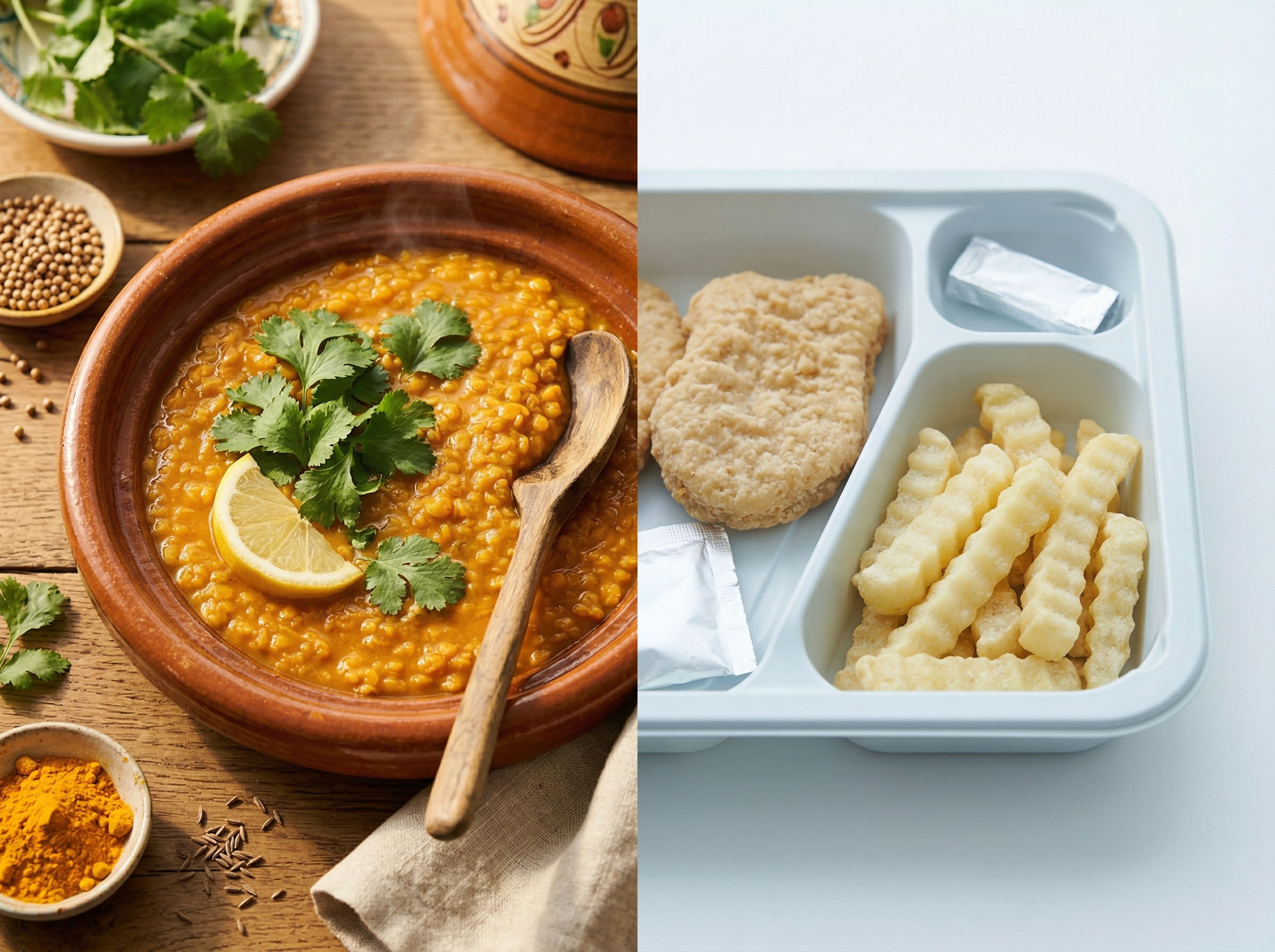
The result of several decades of this experiment is now visible in public health data across the Western world. Obesity rates in the United States have more than tripled since the 1960s. The UK is among the most overweight nations in Europe. Australia follows close behind. These are not random misfortunes. They are, in large part, the compounding consequence of a culture that stopped cooking.
The health effects extend further than most people discuss openly. Chronic overweight is consistently linked in clinical literature to reduced energy, disrupted sleep, elevated inflammatory markers, hormonal imbalance in women, and — something rarely mentioned in polite company — significant reduction in sexual vitality and function in both men and women. Obesity affects testosterone and oestrogen levels, impairs circulation, and is strongly associated with reduced libido and sexual satisfaction. These are not vanity concerns. They are quality-of-life issues that affect marriages, relationships, and the basic human experience of feeling well and alive in one's body.
This is what a culture built on processed convenience has quietly purchased.
📊 Comparison Table
The Women Who Still Know
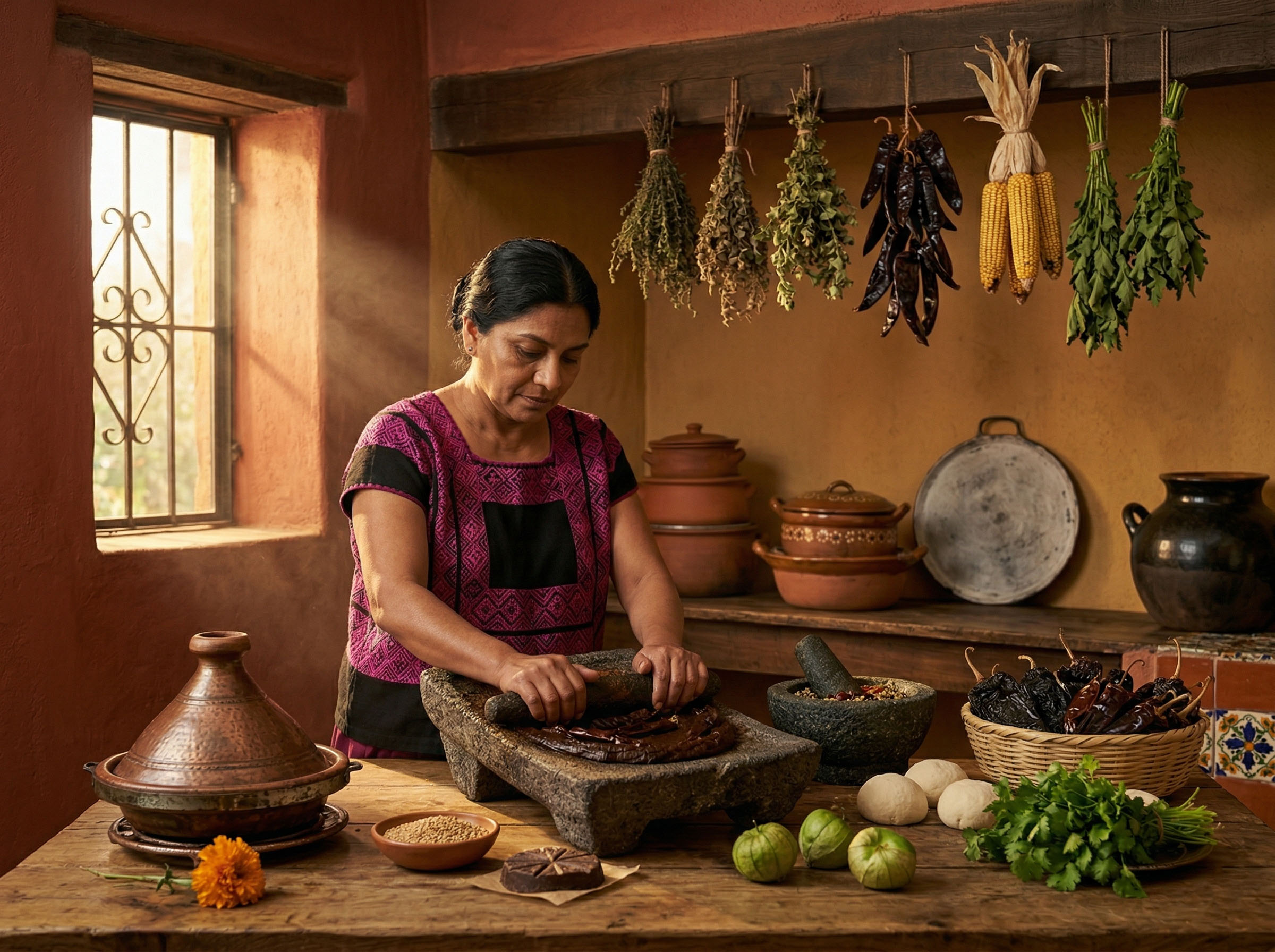
In Oaxaca, a woman named María will wake before dawn to soak dried chillies, char tomatoes directly over an open flame, and grind a mole paste that her mother taught her, and her mother's mother before that. The mole negro she produces contains more than 30 ingredients. It simmers for hours. It is served at weddings, funerals, baptisms, and Sunday lunches. It is not merely food. It is the living memory of a culture, transmitted through the hands of women across centuries.
In India, the concept of sattvic cooking — food that is pure, fresh, and prepared with a calm and loving state of mind — is ancient. Ayurvedic tradition holds that the energy of the cook transfers to the food. Whether one takes that literally or not, the practical reality is clear: food made slowly, with intention and care, using whole spices like turmeric, cumin, coriander, and ginger, is profoundly different from something assembled in a factory and reheated in three minutes. Indian home cooking, at its best, is functional nutrition dressed in extraordinary flavour.
📈 By the Numbers
- 37 minAverage daily time American women spend on food prep and cleanup
- 57%Share of US adult calories from ultra-processed food sources
- 3×Increase in US obesity rates since the 1960s
- #1Japan — longest female life expectancy on earth, built on a traditional whole-food diet
In Morocco, the tagine is both a cooking vessel and a metaphor. Ingredients that seem wholly unrelated — preserved lemon, olives, lamb, saffron, dried apricots — are layered together and slow-cooked until they become something unified and extraordinary. Moroccan women who prepare traditional food are not following a recipe card. They are reading heat, smelling for readiness, adjusting by intuition built from years of practice. That is a kind of intelligence the food industry has no interest in cultivating in its customers.
West Africa's culinary tradition deserves special attention. Dishes like egusi soup, jollof rice, and groundnut stew are built on a foundation of vegetables, legumes, and whole grains that nutritional science is increasingly recognising as exceptional. Palm oil — long maligned in Western health discourse — is now understood to contain significant quantities of vitamin E tocotrienols in its unrefined form. The fermented locust beans used in Nigerian cooking function similarly to miso, supporting gut health in ways that no probiotic supplement can replicate with the same elegance or at the same cost.
💡 Call Out
The women who preserve their food traditions are not living in the past. They are protecting something that modern medicine is now trying to reconstruct from scratch — a relationship between daily eating, gut health, hormonal balance, and long-term vitality. They never lost it because they never stopped cooking.
The Body Knows the Difference
The human gut contains somewhere between 38 and 100 trillion microbial organisms — a figure that dwarfs the number of human cells in the body. This gut microbiome, now understood to be deeply implicated in immune function, mood regulation, hormone metabolism, and weight management, is shaped almost entirely by what we eat. Traditional diets built on fermented foods, diverse plant matter, and whole grains feed this microbiome richly and consistently. Ultra-processed diets do the opposite — they are associated with sharply reduced microbial diversity and a pattern of gut dysbiosis that researchers are linking to a growing list of chronic conditions.
This matters particularly for women. Oestrogen metabolism is partially mediated by gut bacteria. The "estrobolome" — the collection of gut microbes responsible for metabolising oestrogen — is disrupted by poor diet, potentially contributing to hormonal imbalances that affect menstrual health, fertility, perimenopause symptoms, and mood across a woman's lifetime. This is not fringe science. It is being published in peer-reviewed endocrinology journals and discussed at the highest levels of women's health research.
Put more simply: what you eat changes how your hormones work. And how your hormones work changes almost everything else — your energy, your mood, your weight, your skin, your libido, your sleep. The kitchen is not separate from the body. It is, in a very real sense, where the body is made.
Coming Back to the Kitchen
None of this demands perfection. No one is suggesting every woman cook a Moroccan tagine from scratch on a Tuesday night. But there is a meaningful difference between cooking four nights a week and cooking zero. There is a meaningful difference between a pot of lentil soup made in 25 minutes and a packet of instant noodles. The gap in nutrition between these two choices is enormous. The gap in satisfaction — physical and psychological — is equally large.
Across cultures where traditional cooking persists, women report higher levels of satisfaction with meals, stronger family cohesion around the table, and children who are less picky eaters and more naturally drawn to vegetables. The ritual of cooking is also, consistently, reported as a form of stress relief — a time of focus, sensory engagement, and productivity that exists apart from the noise of screens and notifications.
"You do not need a culinary school degree or two free hours every evening. You need a willingness to stop outsourcing the most intimate act of care you perform for your family each day." — Amara Leclerc
The world's most food-proud cultures share one thing: they do not view cooking as a low-status activity. In France, a woman who cooks beautifully is admired. In Italy, the nonna who makes her ragù from scratch commands a kind of reverence that no takeaway order ever could. In Japan, the preparation of a bento box for a child's lunchbox is treated with the same care as any professional task. These cultures have not discovered some complicated secret. They have simply never forgotten that feeding the people you love is one of the most consequential things you will ever do.
The processed food industry did not make us busier. It made us forget what we were busy for.
Questions Women Are Asking
A Return Worth Making
The food traditions of the world are not museum pieces. They are living, breathing systems of knowledge about what the human body needs — knowledge encoded not in textbooks but in the hands of women who learned from women before them. Thai curry pastes. Lebanese za'atar. Nigerian groundnut soup. Indian dal tadka. French pot-au-feu. Mexican black beans. These dishes are not difficult. They are unfamiliar to those who stopped cooking. And that is a distance worth closing.
You do not have to cook every meal. You do not have to be perfect. But every time you stand at a stove with real ingredients and make something for the people you love, you are participating in something that has sustained human health and happiness for longer than any food company has existed. The act of cooking is not domestic servitude. It is one of the most quietly radical things a woman can do in a world that profits from her not doing it.
The world's grandmothers knew this. They still do.
🌿 In Brief — Where to Begin
Five small shifts that connect you to the world's best food wisdom:
- Cook beans from scratch once a week. A pot of Mexican black beans or Indian dal costs almost nothing and feeds a family for days.
- Add one fermented food daily. Yoghurt, miso, sauerkraut, kefir — any of these supports your gut microbiome in ways no supplement can match.
- Replace one processed snack with something whole. Fruit, a boiled egg, nuts, hummus and carrots — the swap is simple; the effect accumulates.
- Learn one dish from another culture each month. Japanese miso soup. Lebanese tabbouleh. Thai green curry. Each one adds a new, nutritionally rich option to your regular rotation.
- Bring children into the kitchen. Children who cook eat better, waste less, and carry a lifelong skill. This is one of the most valuable things a mother can pass on.
Disclaimer: This content is for informational and educational purposes only and does not constitute medical advice. It is not intended to be a substitute for professional diagnosis or treatment. Always consult with a qualified healthcare provider regarding any medical condition or treatment plan. Never disregard professional medical advice because of something you have read here.