日本語
日本語  Deutsch
  English
  Español
  Français
  Português



There is a particular hush that falls over a conversation the moment someone admits, casually and without apology, that they wander around their house without clothes. Eyes dart. Someone changes the subject. Yet step outside the cultural bubble most of us grew up in and you quickly discover that what feels transgressive here is, in large parts of the world, completely unremarkable — as ordinary as making coffee in the morning or letting the dog out at night.
The truth is that home nudity sits in an odd gap in modern life. Society has grown increasingly comfortable talking about bodies in clinical settings and increasingly anxious about bodies in domestic ones. A woman can scroll past a near-naked advertisement on her commute without blinking, yet feel oddly guilty changing in front of her own children. That tension deserves a closer look — not because there is a right answer, but because understanding how other cultures have lived with this question for generations can offer a refreshing sense of proportion.
Where Nudity Is Just Tuesday
If you want to understand a culture's relationship with the unclothed body, start in Scandinavia. In Finland, Norway, Sweden, and Denmark, the sauna is not a luxury — it is a room in the house, or failing that, a shed in the garden. Generations of Finnish families have grown up sharing the sauna without clothing as the most natural thing in the world. Parents, children, grandparents — all together, sweating quietly, talking or not talking, in a space that has no erotic charge whatsoever. It is simply heat, wood, and skin. The Finnish word for sauna modesty does not really exist, because the concept was never needed.
This is not a small cultural quirk. Finland has roughly one sauna for every two people in the country. The sauna tradition was inscribed on the UNESCO Representative List of the Intangible Cultural Heritage of Humanity in 2020. It is, in the truest sense, a national institution — one built entirely on the premise that the unclothed body among trusted family and friends is nothing to manage.
Germany has its own tradition: Freikörperkultur, or FKK — free body culture. It dates to the late 19th century and has survived two world wars, a divided nation, and reunification. At its heart is a simple idea: that clothing is a social tool, not a moral requirement, and that skin in the sun is good for the body and the spirit. German families who participate in FKK culture raise children who grow up entirely comfortable with nudity as a non-event. A naked body at the beach or in the garden simply does not register as significant.
The Netherlands, France, and parts of Austria share similar pockets of this attitude. French naturist resorts have welcomed families for well over a century. The village of Cap d'Agde on the Mediterranean coast is, depending on your perspective, either the world's largest naturist resort or simply a small coastal town where people happen not to wear clothes — and both descriptions are accurate.
Beyond Europe: How Other Cultures Approach the Body
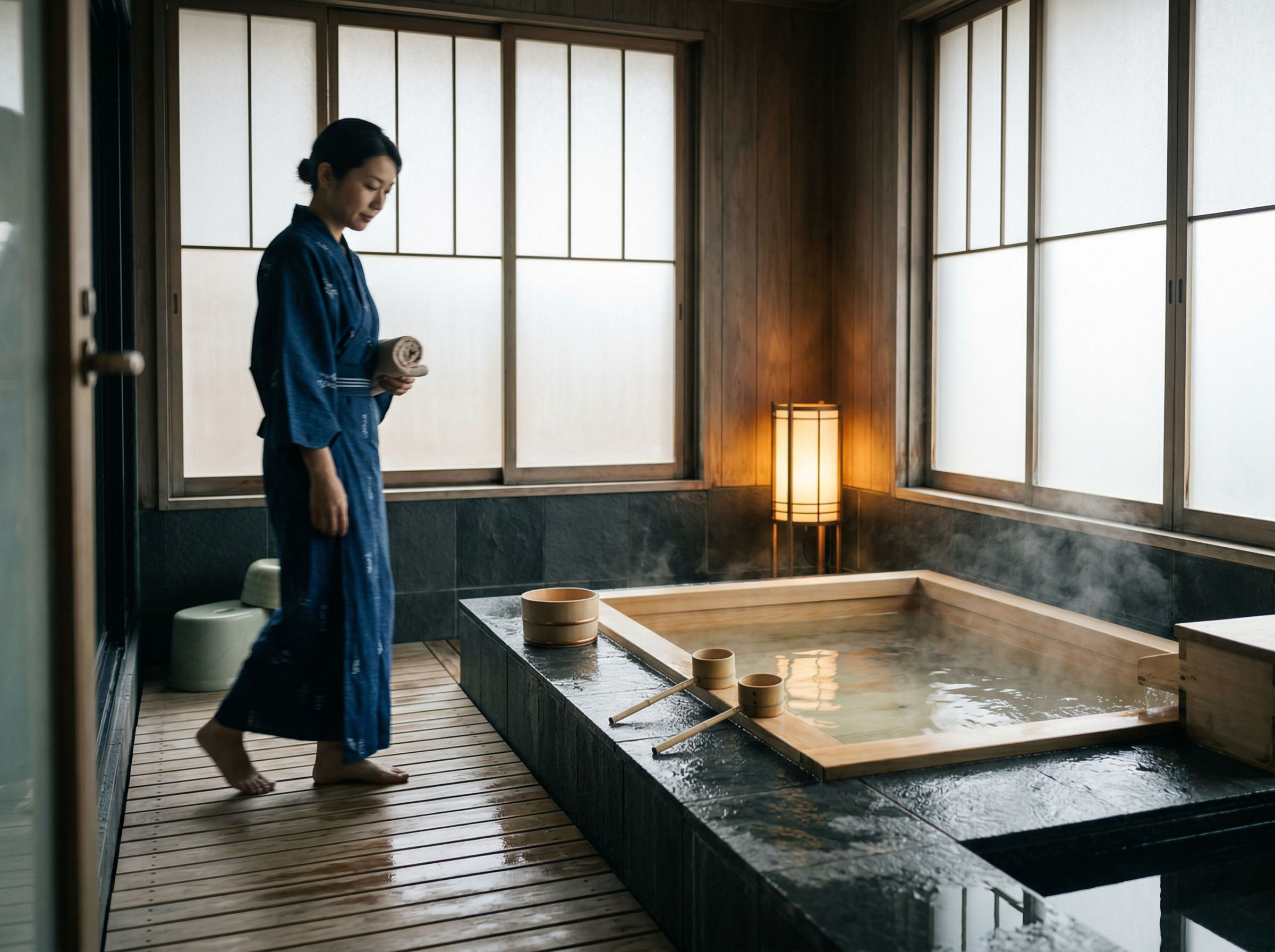
The conversation changes but does not disappear when you move east. In Japan, the sentō (public bath) and onsen (hot spring) have been central to community life for centuries. These are sex-segregated spaces, but within them there is absolutely no clothing. Men bathe together, women bathe together, and the atmosphere is one of relaxed quiet. Children accompany the parent of their gender from a young age. Nobody wraps themselves in towels or averts their eyes. The body, washed, soaked, and seen, is simply the body.
Korean jjimjilbang bathhouses follow a similar pattern. Many are open around the clock and serve as social gathering spots where women sit in the steam room, chat, eat snacks in the communal areas in light shorts and T-shirts provided by the house, and think nothing of the shared washing floors where clothing is left at the locker. It is a practical, communal, completely unselfconscious way of existing with other bodies.
"In cultures where the body is seen every day without drama, body shame tends to be far less pervasive — not because bodies are displayed, but because they stop being a spectacle."
— Amara Leclerc, Cultural Analyst
Further south, in parts of sub-Saharan Africa, partial or full nudity has historically been functional rather than philosophical — tied to climate, labour, and ceremony rather than any statement about liberation or modesty. Colonial-era clothing mandates changed much of this, but in pockets of rural life and in traditional ceremonial contexts, comfort with the unclothed body persists as an inherited norm rather than a chosen lifestyle.
Indigenous communities across South America, parts of Australia, and the Pacific Islands hold similar histories. The Western association of nudity with sexuality or impropriety was, in many cases, an imported idea — one that arrived with missionaries and trade ships and took generations to fully embed.
Closer to Home Than You Think
Here is the part that might genuinely surprise you. Surveys conducted across the United States, the United Kingdom, Canada, and Australia consistently find that a substantial minority of families are comfortable with non-sexual nudity at home — between 25 and 40 percent of respondents in various polls over the past two decades have reported that casual nudity among family members is, to varying degrees, a normal part of their household life. A 2018 survey by the British Naturism organisation estimated that around one in eight British adults described themselves as naturists to some degree, with many practising primarily at home.
These are not people making a political statement or gathering under a movement banner. They are simply ordinary families — wives who sleep nude and cook breakfast that way, mothers who wander from the shower to the laundry pile without stopping to dress, or who let young children join them in the bath, siblings who share a bathroom with the matter-of-fact ease that comes from years of living in close quarters. The act is private and ordinary, which is precisely why it never makes headlines.
✦ Did You Know?
A peer-reviewed study published in the journal Archives of Sexual Behavior (2017) found that children raised in families with non-sexual nudity at home showed no negative outcomes in terms of body image, sexual attitudes, or self-esteem when compared to children raised in more covered households — and in some measures, showed marginally better body confidence. The researchers noted that context and family culture were the determining factors, not nudity itself.
Victorian-era modesty norms — the ones that gave us the idea that exposing skin, even in private, carries moral weight — were a product of a specific time and class. Middle-class British and American families in the 19th century built elaborate frameworks of shame around the body that had not always existed and do not exist everywhere. Those norms were exported through empire, through media, through religion, and they settled into domestic life so thoroughly that many of us now experience them as universal truths rather than historical choices.
But even within the cultures that inherited those norms most deeply, the private home has always been a place where people quietly did things differently. Mothers nursed in living rooms, women shared beds for warmth, families bathed together out of necessity. The gap between public modesty and private practicality has always been wider than social performance suggests.
At a Glance
What Mothers Actually Think
For mothers especially, the question of nudity at home tends to show up in practical terms long before it becomes a philosophical one. Breastfeeding in a shared living space. Bathing a toddler. Getting dressed with a four-year-old sitting on the bathroom floor telling you about their day. Sharing a beach changing room. These are not abstract debates. They are Tuesday mornings.
Many mothers find that their own comfort — or discomfort — with their body in front of their children is shaped less by any deliberate parenting philosophy than by what they absorbed growing up. Women who were raised in households where bodies were treated with quiet practicality tend to carry that ease forward. Women who grew up with bathroom door rules and covered mirrors and whispered words for body parts often find themselves doing the same thing automatically, even when they might consciously prefer not to.
Worth Knowing
Parenting researchers generally agree that the attitude around nudity matters far more than nudity itself. Children learn body norms from the emotional cues of the adults around them. A relaxed, matter-of-fact parent signals that the body is ordinary. An anxious or shame-laden response teaches the child that there is something to be worried about — even if no words are ever spoken.
What changes when a mother adjusts her own relationship with this? Women who have made a conscious decision to be less self-concealing at home — not as a statement, but simply as a practical choice — often describe something quieter than a revelation: a gradual sense that their daughters ask fewer fraught questions about bodies, that their sons treat the human form with more matter-of-fact respect, that the bathroom stops being a charged space and becomes just a room.
This is not a prescription. Families are different. Personalities are different. Cultural and religious backgrounds deserve some respect, but most religious beliefs are human reinterpretations with bias, often reshaped to fit what people think they should be instead of what is natural and realistic. There are limits when they force or shame you into hiding every part of your body. A woman who prefers privacy in her own home is not doing anything wrong. The point is simply that the anxiety around this question — the sense that casual nudity among family members is automatically harmful or improper — is itself a cultural product, not a universal truth.
What Shame Does to Us
Body shame is one of those quiet taxes that women in particular spend a lifetime paying. It shows up in the way a woman hunches slightly in a changing room, or hesitates before stepping onto a beach, or apologises for her body before a doctor has even touched her. It arrives early — studies suggest most girls have begun to experience body-related self-consciousness by age seven or eight — and it tends to stay.
Cultures where home nudity is common and unremarkable do not automatically produce people free of all body image concerns. Life is more complicated than that. But there is something worth noticing in the pattern: in countries with the most relaxed attitudes toward non-sexual nudity — the Nordics, Germany, Japan — the obsessive, punishing relationship with the female body that dominates so much of English-speaking media culture is measurably less intense. It does not disappear. It is just quieter. And quieter is not nothing.
By the Numbers
3.3M
saunas in Finland for a population of 5.6 million
~1 in 8
British adults identify as naturists to some degree (British Naturism survey)
25–40%
of Western families report comfort with non-sexual nudity at home in various surveys
2020
Finland's sauna culture inscribed on UNESCO Intangible Cultural Heritage list
The idea that your body, in your own home, is something that needs to be carefully managed and concealed — even from yourself, even from your children — is a relatively recent and geographically specific invention. It is worth asking, with real curiosity rather than defensiveness, where that idea came from and whether it is actually serving you.
We see certain cultures and religious interpretations that compel women to cover themselves completely. In these environments, treating the female body as inherently dirty leads to daily shame and the expectation that a woman cover up entirely. When a society reaches this extreme, something fundamental has gone wrong. Religion ceases to function as a source of guidance and instead becomes a trap of control and fear for millions of women.
It often begins with people dictating what others are allowed to show or see, then progresses into deepening layers of shame — and sometimes hatred — toward the body, particularly the female body.
Making Space for What Works for You
There is no universal answer here. Choosing to be more relaxed about nudity at home does not require adopting a philosophy or joining anything. It might just mean not scolding yourself when you forget to grab a towel. It might mean letting your daughter see that you move through the world in your body without constant apology. It might mean nothing at all — because your family's comfort and culture is your own to define.
What is worth taking from a broader cultural perspective, though, is the simple reminder that the squeamishness many of us feel about our own bodies in our own homes is not inevitable. It was taught. And if it was taught, it can be examined. Not to be replaced by something else that is forced or performative, but to be held up to the light and asked: does this actually belong to me, or did I just inherit it?
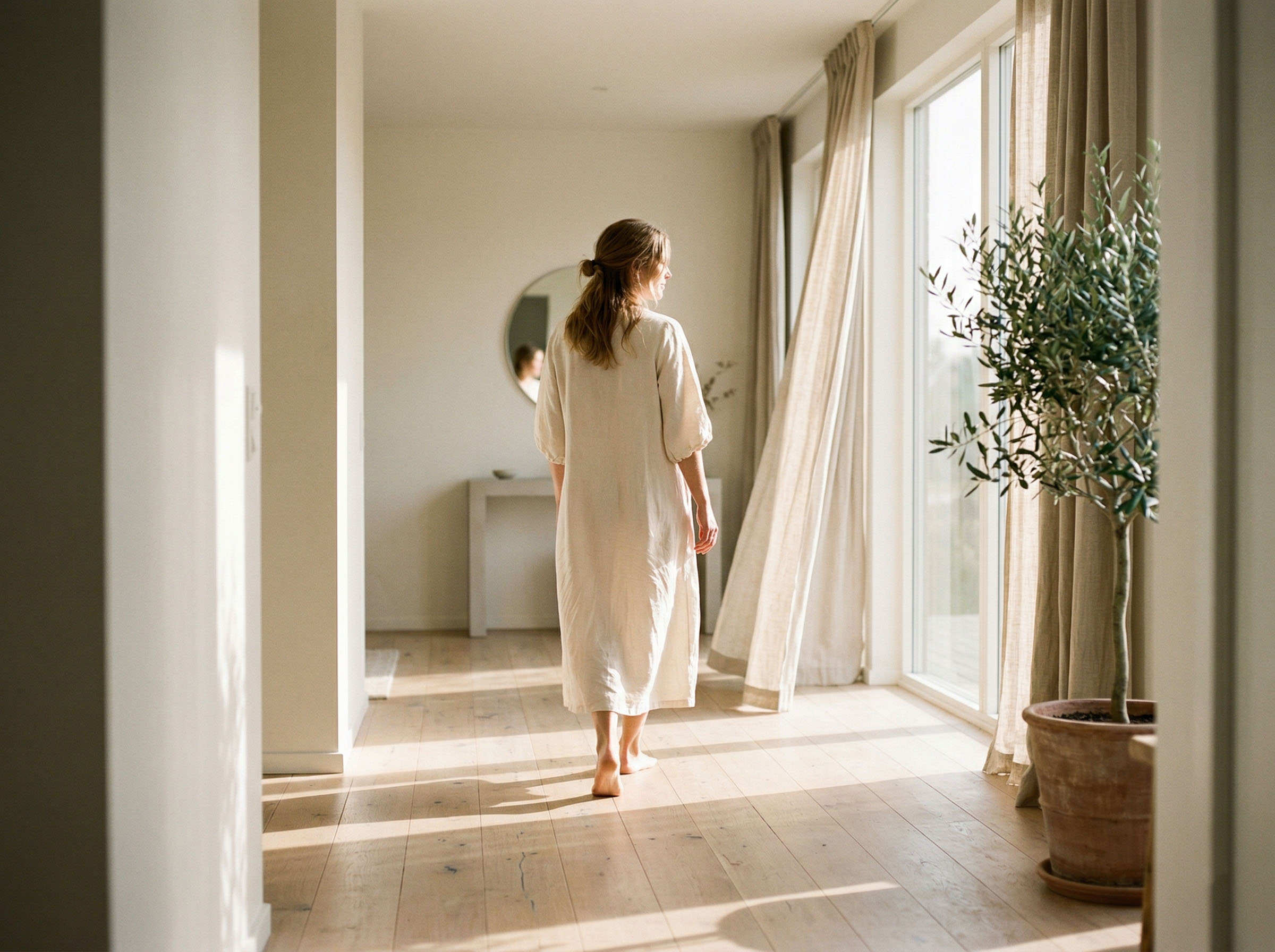
Other cultures have long understood that comfort in one's own skin — at home, with one's family, without performance or pretense — is simply one of the quiet dignities of domestic life. Not a statement. Not a movement. Just a woman in her own house, at ease.
In Brief
- In Finland, Germany, Japan, South Korea, France, and the Netherlands, non-sexual nudity in family and communal settings is culturally ordinary — not exceptional.
- Between a quarter and 40 percent of families in the English-speaking West report comfort with casual nudity at home, though it is rarely discussed publicly.
- Research has not found negative outcomes for children raised in households where non-sexual nudity is present; parental attitude and context are the key variables.
- Victorian-era modesty norms were a historically specific development — not a timeless or universal standard — and they were exported globally through colonial influence.
- How a family approaches this is a private choice. The point is not to change what you do, but to understand why you do it.
Questions Women Ask
Somewhere between the strict modesty of the Victorian parlour and the manufactured boldness of modern media lies something quieter and more useful: the simple, unannounced comfort of being at home in your own body, in your own house, on your own terms. Millions of women around the world live this way — not making a point, not following a trend. Just living. It is, when you think about it, one of the most ordinary things in the world.
Disclaimer: This content is for informational and educational purposes only and does not constitute medical advice. It is not intended to be a substitute for professional diagnosis or treatment. Always consult with a qualified healthcare provider regarding any medical condition or treatment plan. Never disregard professional medical advice because of something you have read here.