日本語
日本語  Deutsch
  English
  Español
  Français
  Português



There is a moment that happens to almost every woman who picks up a weight for the first time. She looks around the gym, feels slightly out of place, and wonders whether any of this is really meant for her. Rows of dumbbells, racks of barbells, men who seem to know exactly what they are doing — it can feel like walking into someone else's world.
But here is the truth that the fitness industry has been slow to say plainly: strength training is one of the most powerful things a woman can do for her health, her hormones, her mood, and her long-term quality of life. Not as an afterthought to cardio. Not as a way to "tone up." As a genuine, science-backed priority — especially during and after the childbearing years, perimenopause, and beyond.
This guide is designed to walk you through everything you need to get started — from understanding why women respond to strength training differently than men, to knowing what to do on your very first day on the floor.
"Strength training is not about becoming someone else. It is about becoming more fully yourself — stronger, steadier, and more at home in your own body."
— Emma Sterling
Why Women and Strength Training Are a Natural Match
Women have historically been steered toward cardio — long runs, aerobics classes, cycling — while weight rooms were quietly coded as male territory. That cultural assumption has done a disservice to women's health for decades.
The female body responds exceptionally well to resistance training. Muscle tissue is metabolically active, meaning the more of it you carry, the more efficiently your body burns fuel at rest. For women managing weight, blood sugar, or energy levels, this is not a small detail — it is foundational.
Strength training also plays a direct role in hormonal health. Regular resistance exercise improves insulin sensitivity, supports healthy cortisol regulation, and has been shown to positively influence estrogen metabolism. For women navigating PMS, PCOS, perimenopause, or thyroid challenges, building muscle is one of the most practical tools available — no prescription required.
And then there is bone density. Women are significantly more susceptible to osteoporosis than men, with bone loss accelerating sharply after menopause. Weight-bearing and resistance exercises are among the most effective ways to maintain and even rebuild bone density throughout a woman's life. Starting in your thirties or forties is not too late. Starting in your fifties is not too late either.
✨ Did You Know?
Women can lose up to 20% of their bone density in the five to seven years following menopause. Consistent strength training — even just two sessions per week — has been clinically shown to slow or reverse this decline.
What "Strength Training" Actually Means for Beginners
Strength training, at its core, means asking your muscles to work against resistance. That resistance can come from free weights (dumbbells, barbells, kettlebells), machines, resistance bands, or even your own bodyweight. All of them count. All of them work.
The goal in the beginning is not to lift the heaviest weight in the room. The goal is to teach your body how to move correctly under load — a process called neuromuscular adaptation. In your first four to eight weeks of training, most of your strength gains will come not from larger muscles, but from your nervous system learning to recruit and coordinate the muscle fibers you already have. This is why beginners often feel dramatically stronger after just a few weeks even when their physique hasn't visibly changed.
Progressive overload is the single most important principle to understand. It simply means gradually increasing the challenge over time — more weight, more repetitions, less rest, or a harder variation of an exercise. Without this, your body adapts and stops changing. With it, results keep coming.
🆕 Quick-Start Box: Your First Month in the Weight Room
What You Need
- A set of light, medium, and heavy dumbbells (or access to a gym rack)
- Supportive training shoes with a flat or low heel
- A simple workout log (notebook or phone app)
- 30–45 minutes, 2–3 times per week
Do's
- Start with compound movements: squats, hinges, pushes, pulls, and carries
- Focus on form before adding weight
- Rest 48–72 hours between training the same muscle group
- Track your weights and reps each session
- Eat enough protein — aim for 0.7–1g per pound of bodyweight daily
Don'ts
- Don't skip warm-up sets — start with a lighter version of your first exercise
- Don't train to complete failure every set (save that for later stages)
- Don't compare your starting point to someone else's middle
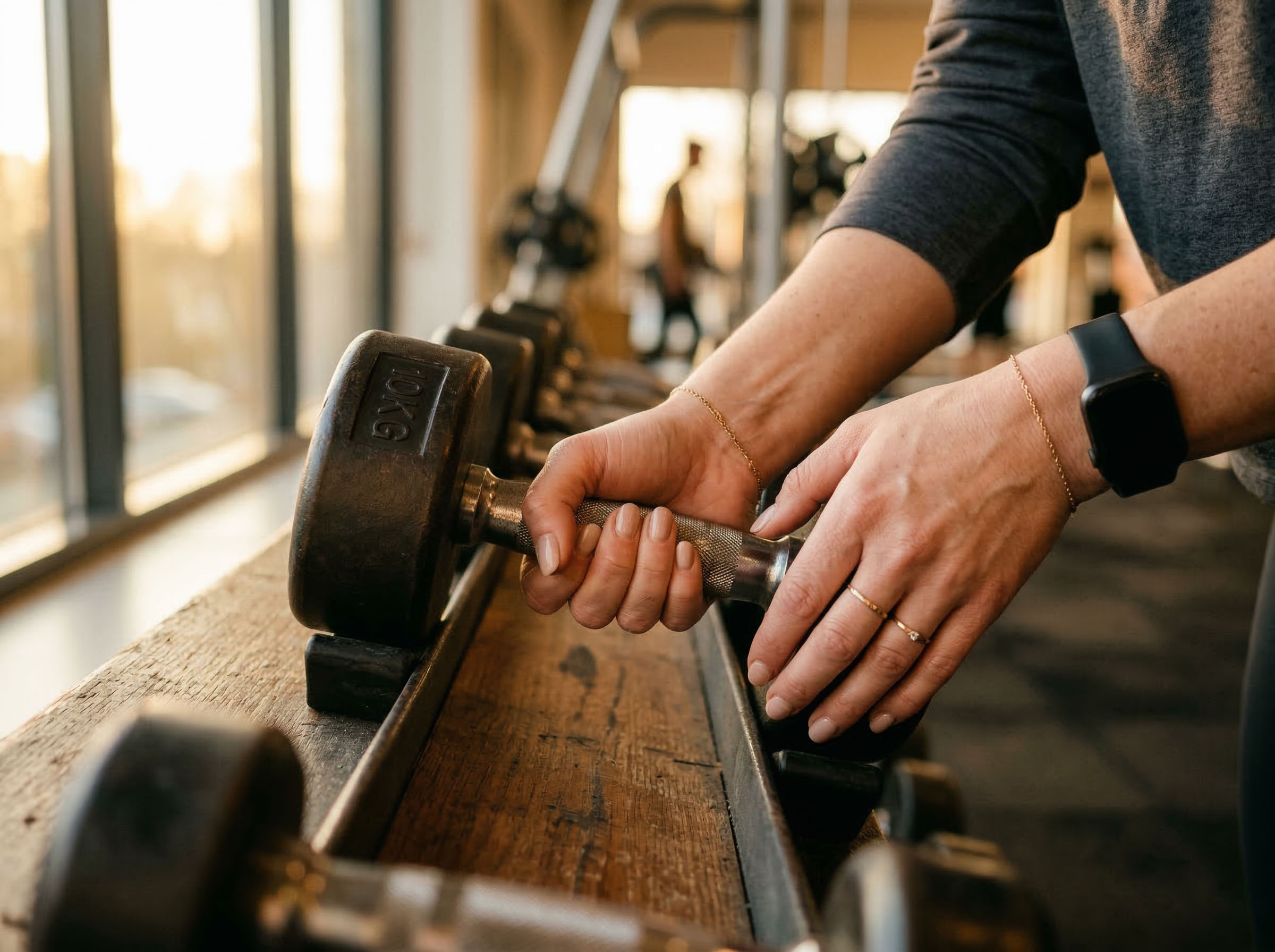
- Don't avoid the "heavy" side of the dumbbell rack — women are not limited to the 5-lb weights
The Five Movements Every Woman Should Learn First
Rather than memorizing a laundry list of exercises, beginners are best served by mastering five fundamental movement patterns. Everything else in the gym is essentially a variation of these.
The Squat. The squat is a knee-dominant lower body movement that trains your quads, glutes, and core together. Goblet squats — holding a single dumbbell at your chest — are the best starting point. They naturally teach you to keep your chest tall and your weight in your heels.
The Hip Hinge. This is the foundation of deadlifts, Romanian deadlifts, and kettlebell swings. Learning to push your hips back while maintaining a neutral spine protects your lower back and builds powerful glutes and hamstrings. Start with a Romanian deadlift using light dumbbells before adding a barbell.
The Horizontal Push. Think chest press, push-up, or dumbbell bench press. This pattern trains your chest, shoulders, and triceps. Push-ups are underrated — a full push-up with perfect form is harder than most people assume and a worthy goal in itself.
The Horizontal Pull. Rows — seated cable rows, dumbbell rows, or resistance band rows — counterbalance all the pushing we do in daily life. They strengthen your upper back and are especially important for posture, which tends to suffer after years of desk work, driving, and carrying children.
The Carry. Pick up something heavy and walk with it. Farmer's carries train your grip, your core, your posture, and your conditioning simultaneously. They are one of the most functional exercises in existence and one of the most ignored.
| Day | Focus | Key Movements | Sets × Reps |
|---|---|---|---|
| Day 1 | Full Body A | Goblet Squat, Dumbbell Row, Push-Up | 3 × 10–12 |
| Day 2 | Rest or Light Walk | 20–30 min easy movement | — |
| Day 3 | Full Body B | Romanian Deadlift, Chest Press, Farmer's Carry | 3 × 10–12 |
| Day 4 | Rest or Yoga / Stretching | Mobility and recovery | — |
| Day 5 | Full Body C (optional) | Lunge variation, Overhead Press, Plank | 3 × 10–12 |
Hormones, Your Menstrual Cycle, and How to Train Smarter
One of the most exciting frontiers in women's fitness research involves training in sync with the natural hormonal shifts of the menstrual cycle. This is not about restricting yourself during certain phases — it is about understanding that your body's readiness to perform, recover, and build changes across the month, and that you can use that rhythm to your advantage.
In the follicular phase (days one through roughly fourteen, starting with your period), estrogen rises steadily. Most women notice higher energy, better recovery, and stronger performance during this window. This is a natural time to push harder, try heavier weights, or attempt new personal bests.
After ovulation, the luteal phase brings rising progesterone and a gradual drop in estrogen. Many women notice fatigue, increased body temperature, and slightly longer recovery needs. This does not mean stopping training — it means adjusting expectations and perhaps reducing intensity or volume by ten to twenty percent. Your best training partner is awareness, not a rigid schedule.
For postmenopausal women or those on hormonal birth control, the cycle-based approach is less directly applicable, but the principle holds: listen to how your body responds week to week and adjust accordingly. Consistency over months matters far more than optimizing any single session.
🌏 Cultural Insight
Women and Physical Strength Through History
Long before modern gyms existed, women's physical strength was simply a fact of daily life. Women in agrarian societies routinely carried water, worked fields, kneaded bread, and managed livestock — physical tasks that built real functional strength.
The idea that women are naturally fragile is largely a 19th-century upper-class invention. Across most of human history, strong women were not the exception — they were the norm. Today's gym culture is, in some ways, simply reclaiming that tradition.
The Protein Question: Fueling Muscle Without Overthinking It
Nutrition could fill an entire magazine on its own, but one point stands above the rest for women beginning strength training: most women do not eat enough protein to support muscle growth and recovery.
Protein is the raw material your body uses to repair and build muscle tissue after a training session. Without adequate intake, even the best programming delivers diminished results. The general recommendation for active women doing resistance training is between 0.7 and 1 gram of protein per pound of bodyweight per day — meaningfully higher than what most women consume by default.
Good protein sources include eggs, Greek yogurt, cottage cheese, chicken, fish, lean beef, legumes, and protein supplements if needed. The timing matters less than the total. Focus first on hitting your daily target before worrying about post-workout windows.
💡 In Brief: Strength Training & Hormonal Health
- Resistance training improves insulin sensitivity, which supports healthy blood sugar and weight management.
- Regular lifting helps regulate cortisol — your body's primary stress hormone.
- Muscle mass declines with age; training from your 30s onward can significantly slow this process.
- Women who strength train report better sleep quality, reduced PMS symptoms, and improved mood.
- Even two sessions per week produce measurable hormonal and physical benefits.
The Fear of "Bulking Up" — Let's Put It to Rest
The single most persistent myth in women's fitness is that lifting weights will make a woman look bulky or masculine. This fear stops countless women from ever picking up a weight heavier than five pounds, and it is worth addressing plainly.
Women have roughly ten to thirty times less testosterone than men — the primary hormonal driver behind large muscle gains. For a woman to develop a physique that looks "bulky" in the way many fear, she would need years of highly specific, very high-volume training combined with deliberate nutritional strategies designed to maximize muscle mass. It does not happen accidentally.
What strength training reliably produces in women is a leaner, more defined shape — not by adding excessive bulk, but by increasing the proportion of muscle relative to fat. The women you admire for being fit and strong? They almost certainly lift weights regularly and eat enough protein. The "toned" look is, biologically, a muscled look.
Home Training vs. the Gym: Where Should You Start?
Both work. Neither is superior. The best environment is the one you will actually show up to consistently.
Training at home with a set of adjustable dumbbells and resistance bands removes the intimidation factor entirely and eliminates commute time — a real advantage for mothers with young children or demanding schedules. The limitations are a somewhat restricted exercise selection and the absence of heavier load options as you advance.
A gym provides access to a full range of equipment, heavier weights, and often a community atmosphere that keeps motivation higher over time. If cost is a concern, most basic gyms are accessible on modest monthly memberships.
If you choose a gym, consider booking one or two sessions with a certified personal trainer specifically to learn form on the compound movements. You do not need ongoing personal training — just enough guidance to start with confidence. Many gyms offer this as an introductory service.
What to Expect in Your First Three Months
Weeks one and two will likely feel awkward. Your brain is learning new movement patterns, you will be sore in places you did not expect, and you may question whether you are doing it right. This is completely normal. The soreness — known as delayed onset muscle soreness, or DOMS — peaks around 24 to 72 hours after a session and diminishes significantly after the first few weeks.
By weeks three through six, movements that felt clumsy start to feel natural. You will notice you can lift more than you could initially. Your posture may begin to improve. Sleep often gets noticeably better around this point.
Months two and three are when the visible changes tend to become more apparent. Clothing fits differently. Everyday tasks — carrying groceries, climbing stairs, picking up children — feel easier. The gym stops feeling like foreign territory and starts feeling like part of your routine.
Progress in strength training is not always linear. There will be sessions where everything clicks and sessions that feel flat. Both are part of the process. Show up anyway.
❓ Your Questions Answered: Strength Training for Beginners
Starting Small, Staying Consistent
The women who see the most lasting results from strength training are not the ones who start with the most ambitious program. They are the ones who start with something manageable — two days a week, a handful of movements, weights that feel respectfully challenging — and simply keep showing up.
You do not need to overhaul your life to start. You need a plan, a little space, and the willingness to be a beginner. Every woman who has ever built strength and confidence in the weight room started exactly where you are right now: at the beginning, a little uncertain, with everything still ahead of her.
Pick up something heavy. Put it down. Come back and do it again. That is all there is to it.
Disclaimer: This content is for informational and educational purposes only and does not constitute medical advice. It is not intended to be a substitute for professional diagnosis or treatment. Always consult with a qualified healthcare provider regarding any medical condition or treatment plan. Never disregard professional medical advice because of something you have read here.