English
  Español
  Português



There is a very specific kind of joy that only a warm, white-sand beach can give you. The salt air hits you at the arrivals terminal. You feel your shoulders drop two inches. Everything back home — the group chats, the to-do lists, the sensible shoes — suddenly feels very, very far away. Whether you are heading to the Turks & Caicos for a girls' trip, following your partner to a resort in Bali, or finally crossing a topless beach in the south of France off your bucket list, a tropical beach holiday is one of life's genuinely great pleasures.
Packing for it, however, can feel surprisingly stressful. You want to look good. You want to feel good. You want to be prepared for sun, sand, sea, spontaneous adventures, and — let's be completely honest — the possibility of a really excellent vacation romance. This list is not about packing a single polished lip gloss and calling it done. This is about the seven things that actually matter when the weather is hot, the vibe is free, and you are fully, unapologetically off the clock.

"A warm tropical beach is the only place where being completely unprepared is romantic. Being completely unprepared with chafed skin and a dead phone is just a bad vacation."
— Sienna Duarte1. A Broad-Spectrum SPF 50+ Sunscreen — The One You Will Actually Use
Every list like this starts with sunscreen, and with good reason. A tropical sun is not the same animal as the pale afternoon sun you get back home. At beach latitudes, UV radiation is more intense, the reflection off water amplifies exposure, and the wind creates a false sense of coolness that makes you forget you are essentially sitting inside a slow oven.
The issue is not whether to wear sunscreen — it is choosing one you will not skip because it feels horrible. Heavy, white, greasy formulas get left in the bag. Find a mineral-hybrid SPF 50 or higher that blends easily into your skin tone, comes in a generous size, and, importantly, has some water resistance. Reapplication every 90 minutes is non-negotiable, especially if you are in and out of the water. Many women swear by a separate SPF stick for the face and a spray or lotion formula for the body, because convenience is what keeps you actually protected.
Pay attention to reef-safe formulations too — many destinations including Hawaii, Bonaire, and Palau have restrictions on oxybenzone and octinoxate to protect coral ecosystems. It is worth checking before you travel. The U.S. Environmental Protection Agency's sunscreen guidance is a reliable reference for understanding what ingredients matter and why.
☀️ Did You Know?
Sand reflects up to 25% of UV rays back at you, meaning even sitting under an umbrella at the beach gives you significant UV exposure. Sunscreen on the underside of your chin and nose is not optional — it's the part women most commonly miss.
2. A Quality After-Sun and Skin Recovery Balm
No matter how diligent you are, tropical sun will work on your skin. Wind, salt, hours of outdoor heat — even without burning, skin dehydrates faster than you expect. An after-sun lotion or balm applied each evening is the difference between waking up with glowing, supple skin and waking up feeling like a sun-cured piece of driftwood.
Aloe vera-based gels are the classic choice and remain excellent. But some women prefer richer formulas with hyaluronic acid, ceramides, or vitamin E for deeper overnight recovery, particularly if they have drier skin types. A small pot of pure coconut oil does double duty as an after-sun, a hair mask for the ends of saltwater-damaged hair, and a general moisturiser — compact and wildly effective.
Pack this in your carry-on rather than your checked bag. Arriving at a tropical destination after a long-haul flight and immediately applying after-sun is the kind of self-care that sets the tone for an entire holiday.
3. Swimwear That Fits Your Body and Your Plans
🌺 Cultural Insight
Topless & Nude Beach Etiquette Around the World
France & Spain: Topless sunbathing is completely normalized on most public beaches. Nudity is common at designated naturist areas like Cap d'Agde.
Brazil: The tanga (string bikini) culture is mainstream. Nudity is less common outside specific clubs, but body confidence is celebrated.
Croatia: Known for naturist resorts along the Adriatic. FKK (Freikörperkultur) spots are well-established and family-friendly.
Always research local laws before disrobing — what's accepted in one country can carry a fine in another.
This sounds obvious until you find yourself at a beautiful cove with swimwear that is either falling off during a wave or so tight it is leaving welts. Good beach swimwear is worth investing in because it is doing something genuinely athletic — staying on through surf, providing some support, drying quickly, and keeping its shape wash after wash.
The planning part matters. Are you going to a standard resort pool? A structured underwire one-piece or bikini top with proper closure hardware will serve you well. Are you thinking about a nude or topless beach? Pack something you can remove comfortably and carry easily — a simple triangle bikini or pareo wrap. Are you doing water sports, surfing, or snorkelling? A rash guard or a supportive sports bikini with secure ties is essential.
A note on fit specifically: the swimwear industry has improved enormously in recent years with size-inclusive cuts, adjustable straps, and longer torsos for taller women. If your drawer at home is full of swimwear that never quite fits, a tropical trip is an excellent excuse to invest in one or two proper pieces. You will wear them constantly.
4. Chafe and Friction Protection — The Thing Nobody Talks About Enough
Heat plus humidity plus skin-on-skin contact plus a full day walking between beach bars, market stalls, and waterfront restaurants is a perfect recipe for chafing. Inner thighs, underarms, anywhere a wet bikini sits against skin — it is miserable, it can turn into a rash, and it is entirely preventable.
Anti-chafe balm sticks (similar in texture to a deodorant stick) are lightweight, invisible, and genuinely life-changing in a hot climate. Apply them to inner thighs before long walks, under swimwear straps, anywhere you know friction builds. Some women also use a lightweight body powder for dry conditions. Either way, pack it. It takes up almost no space and it will save at least one afternoon of your holiday.
💡 Pack Smart
For a two-week tropical holiday, a small dry bag (10–15L) is one of the most underrated items you can bring. Waterproof your phone, sunscreen, and anti-chafe stick in one bag that comes into the water with you. It doubles as a beach bag during hikes, boat trips, and excursions where a regular tote would be destroyed. Bonus: bright colours mean you can find it instantly in the sand.
5. Intimate Hygiene Essentials Suited to a Hot Climate
A change in climate, long days in wet swimwear, tropical heat, and sometimes unfamiliar water or food all affect your body in ways you might not expect until you're mid-holiday. Women who are prone to pH imbalances or yeast infections know that a hot beach holiday can sometimes be a trigger — and being prepared is far easier than scrambling for a pharmacy in a foreign language.
Travelling with a gentle, pH-balanced intimate wash is wise — not because daily soap is necessary down there, but because rinsing salt and chlorine away after swimming with something designed for that skin is genuinely kinder than generic hotel body wash. Pack a small travel size. Equally, breathable cotton underwear for evenings (rather than tight synthetic fabrics) gives skin a chance to recover between beach days.
If you use tampons or a menstrual cup, confirm availability in your destination country before you go. In many tropical destinations, your preferred brand or absorbency may simply not exist at the local pharmacy. The same goes for any specific products that are part of your regular routine. Carry what you know, in the amount you need.
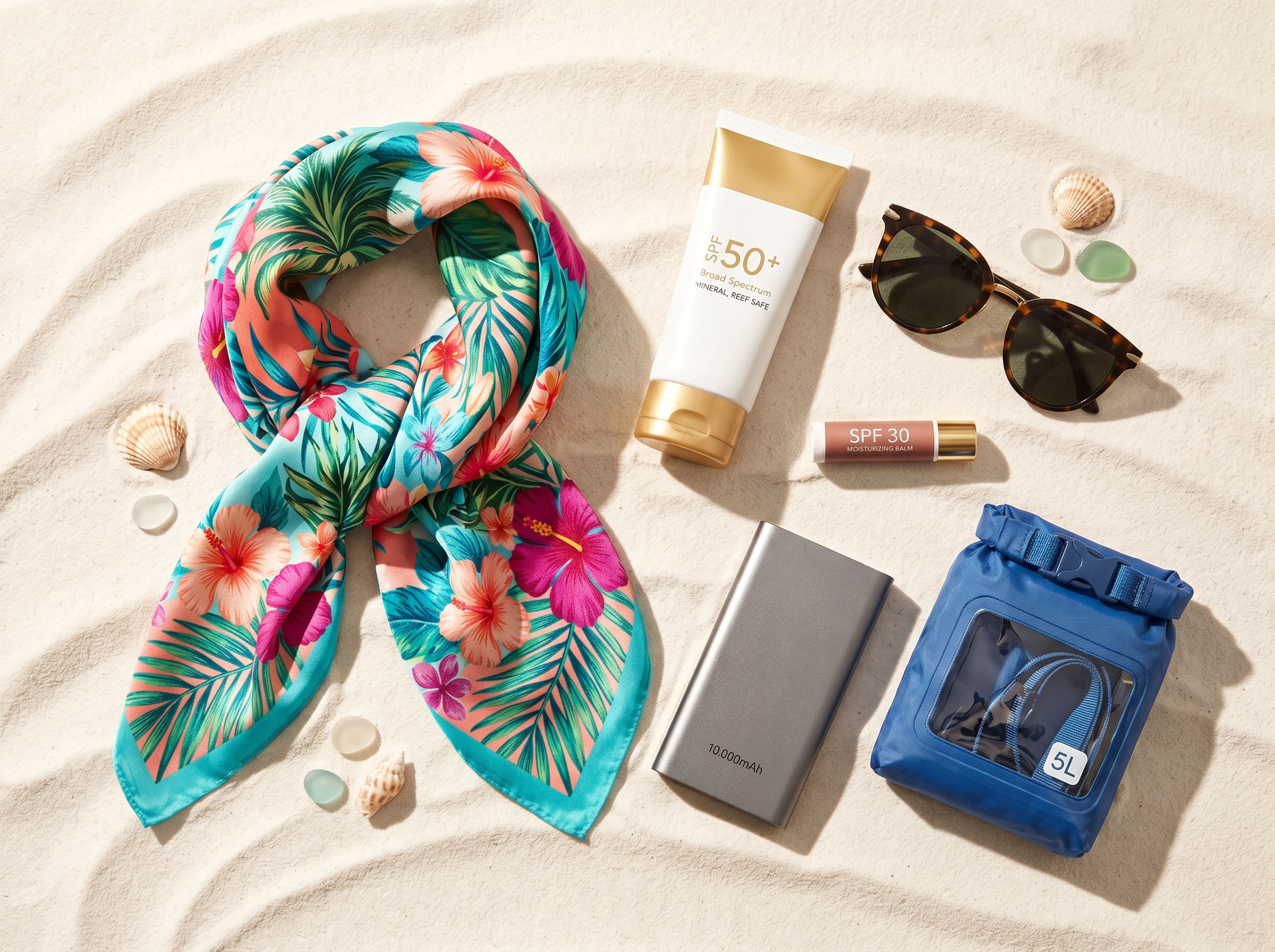
6. A Reliable Waterproof SPF Lip Balm and a Multipurpose Facial Mist
The face takes the hardest hit on a beach holiday, and the lips are almost always the most neglected part. Lips have no melanin — they can burn just as badly as any other skin, and the combination of salt water, sun exposure, and dehydration turns lips chapped and cracked within days if you are not proactive about it.
A tinted SPF lip balm at SPF 30 or higher is the simplest, most effortless solution — it gives a flush of colour, a bit of moisture, and sun protection all at once. Reapply constantly. Keep one in your beach bag and one by your sunscreen.
A good facial mist is a smaller luxury that earns its carry-on space. A few spritzes of something containing rosewater, glycerin, or hyaluronic acid in the afternoon gives you an instant refresh, settles any makeup or SPF you have reapplied, and — on a purely sensory level — is just delightful when you are hot and sun-dazed. It also works as a quick cooldown for skin that has had too much sun.
📊 By the Numbers — Sun & Skin
90 min
Max time before sunscreen reapplication in direct tropical sun
25%
UV rays reflected back by white sand — even under a beach umbrella
80%
Of UV reaches you even on overcast beach days
7. A Charged External Battery Pack — And the Confidence to Leave Your Phone in the Bag
This last essential is a two-part thing, and both parts matter equally. First, the practical: a compact, high-capacity portable battery charger is non-negotiable for beach travel. Your phone will die faster in heat. Navigation, translation apps, ride-hailing, contactless payments, and the camera you will absolutely be using — all of it depends on a charged phone. A 20,000mAh battery pack can charge your phone four to five times and weighs less than most sunscreen bottles. Keep it in your dry bag.
The second part is about something that is harder to pack: permission to put the phone face-down and be present. A beach holiday — especially a warm, tropical one that may involve a topless cove or a naturist resort — is one of the most sensory experiences available to a woman. The warmth on your back, salt on your lips, the sound of water, someone you find very attractive walking past. The phone, for stretches of time, should be an option rather than a reflex.
It is a slightly unfashionable thing to say, but a beach trip is one of the few times when being slightly unreachable is actually the goal. The battery pack is there so that when you do want your phone, it works. The rest of the time, it's for the beach bag.
"Permission to be somewhere fully — not just physically — is perhaps the most important thing you can pack. The battery pack just makes sure you can call a taxi home."
— Sienna DuarteYour Tropical Beach Packing Checklist at a Glance
Frequently Asked Questions
📋 In Brief
- Broad-spectrum SPF 50+ sunscreen in a formula you will actually use — and reapply. Reef-safe where required.
- After-sun recovery balm applied every evening keeps skin glowing rather than peeling.
- Swimwear matched to your plans — including something easy to remove if topless or naturist beaches are on your itinerary.
- Anti-chafe balm for inner thighs and strap areas — non-negotiable in tropical heat.
- Intimate care products suited to your body, brought from home — don't rely on local pharmacies.
- SPF lip balm and a hydrating facial mist for constant lip and face protection.
- A charged battery pack in a dry bag — and permission to leave the phone face-down for stretches of time.
A warm tropical beach can be exactly as good as you imagine it will be. It can be golden and indulgent and deeply restoring. Or it can be a sun-burned, chafed, under-prepared version of the holiday you planned. The difference, almost always, comes down to seven things in your bag — and the willingness to actually use them.
Wherever your beach happens to be this year, pack well, take your time getting there, and once you arrive, be completely, unreservedly there.
📚 Trusted References
- U.S. Environmental Protection Agency — Sunscreen: The Facts — ingredient safety, reef impact, and SPF guidance.
- The Skin Cancer Foundation — Sunscreen Guide — evidence-based SPF recommendations and application best practices.
Disclaimer: This content is for informational and educational purposes only and does not constitute medical advice. It is not intended to be a substitute for professional diagnosis or treatment. Always consult with a qualified healthcare provider regarding any medical condition or treatment plan. Never disregard professional medical advice because of something you have read here.