English
  Español
  Português



Whether you shave, trim, wax, or keep things completely natural, the choices women make about their intimate grooming are deeply personal. There is no single "right" answer, and no style that carries more worth than another. What does matter — regardless of where you land on that spectrum — is that however you choose to groom, you do it safely.
The vulva is one of the most sensitive areas of the body — it deserves the same thoughtful care you give to your face, not a rushed afterthought at the end of a shower.
— Lexi PierceThe skin around the vulva is thin, delicate, and rich in nerve endings. It lacks the protective sebaceous layer found on the face and is frequently exposed to friction, moisture, and clothing. That combination makes it especially prone to irritation, ingrown hairs, micro-tears, and infection when grooming goes wrong. The good news is that a few straightforward habits can make the entire experience more comfortable, more effective, and far less likely to leave you dealing with redness or bumps for the next three days.
These seven tips are grounded in dermatological common sense and the kind of real-world experience that most women piece together over years of trial and error. Consider this the shortcut.
Did You Know?
The vulva's skin pH sits between 3.8 and 4.5 — slightly more acidic than most body skin. Standard soap, which is often alkaline, can disrupt this balance and trigger dryness, itching, or bacterial overgrowth. Even grooming products that feel gentle elsewhere may be too harsh here.
1. Know What You're Working With
Before picking up any tool or product, it helps to understand the basic geography. The vulva refers to all the external genital structures — the mons pubis (the padded area over the pubic bone), the labia majora (outer lips), the labia minora (inner lips), the clitoral hood, and the vaginal opening. The vagina is the internal canal; grooming stays external.
This distinction matters because the skin varies significantly across these zones. The mons pubis and outer labia have skin more similar to the rest of the body — thicker, capable of handling standard shaving with the right prep. The inner labia and the tissue closer to the vaginal opening are far more delicate. Any product, razor, or implement that makes contact with those areas needs to be chosen carefully.
Take a moment, in good lighting, to get genuinely familiar with your own anatomy. Knowing where the folds and creases are will help you shave or trim more accurately and reduce the chance of nicks. This isn't clinical — it's practical.
★ Quick-Start Guide — Your Grooming Kit
What You Need
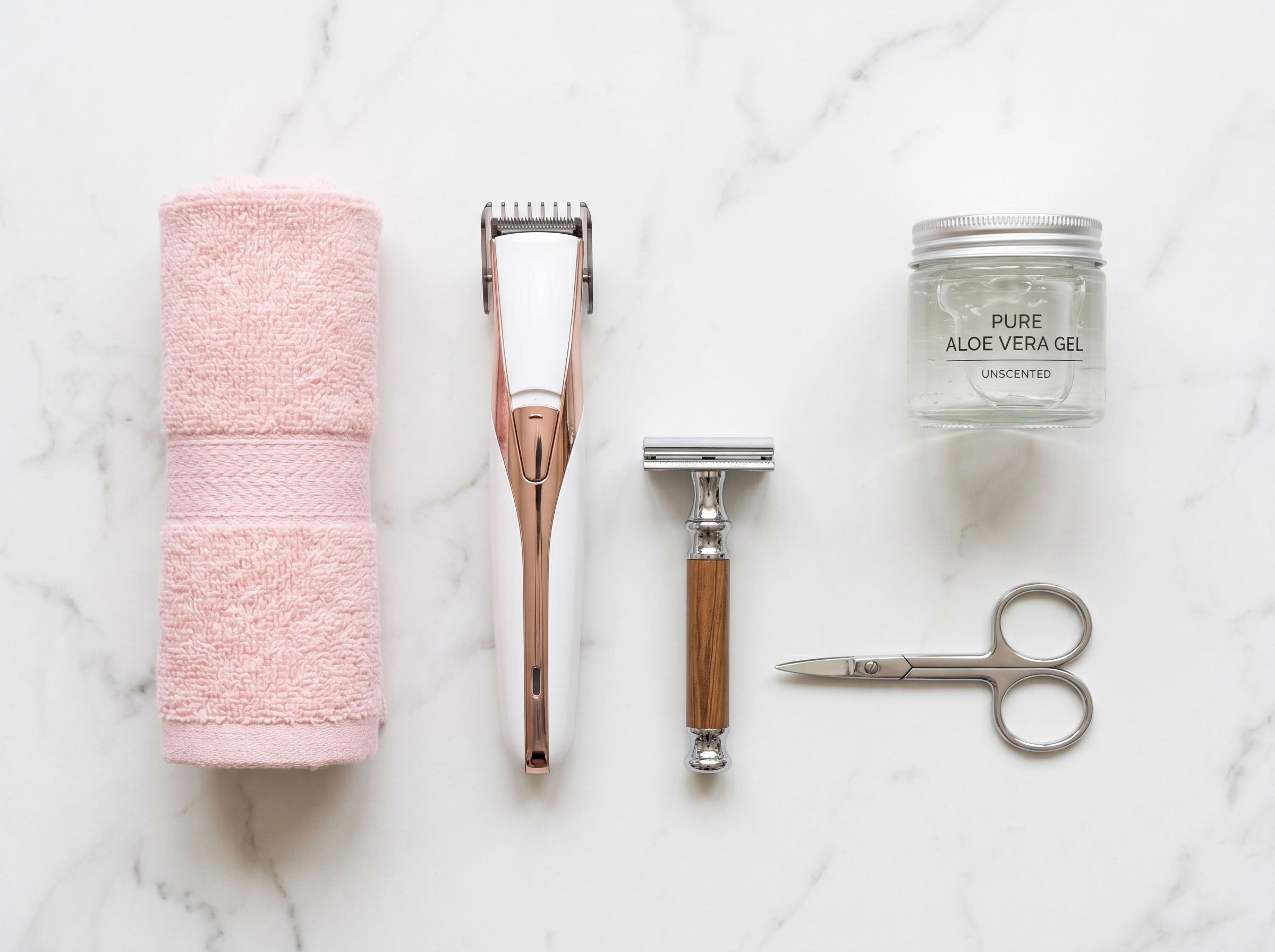
- A fresh, sharp single- or double-blade razor
- Fragrance-free shaving gel or coconut oil
- Small trimming scissors or a bikini trimmer
- Fragrance-free, gentle cleanser
- Unscented, alcohol-free moisturizer or pure aloe gel
- Clean, soft towel or cotton pads
✓ Do
- Soften skin in a warm bath or shower first
- Shave in the direction of hair growth
- Rinse tools thoroughly after each use
- Moisturize once the skin is dry
✕ Don't
- Use a dull or shared razor
- Apply regular body lotion or perfume
- Shave over already irritated skin
- Exfoliate immediately after shaving
2. Prep Comes First — Always
Rushing straight into shaving or trimming on dry skin is the single most common reason women end up with irritation, razor burn, and ingrown hairs. Proper preparation only takes a few minutes and makes a significant difference in the outcome.
The most effective prep happens in the shower or bath. Spending at least five minutes in warm (not hot) water softens the hair shaft and gently opens the follicle, making the hair easier to cut cleanly. Heat also relaxes the skin, reducing the friction a blade has to overcome.
If you're trimming rather than shaving, prep still matters — clean, dry skin is easier to work with than damp or sweaty skin, which causes scissors and trimmers to pull or snag. Trim before the shower, shave after.
A light exfoliation of the outer pubic area (mons and outer labia only — skip the more sensitive inner zones) a day or two before shaving can help clear dead skin cells that might trap hairs beneath the surface. Use a soft washcloth rather than a harsh scrub. And never exfoliate immediately before or after shaving — the skin needs recovery time between those two forms of friction.
3. Choose the Right Tool for the Job
Not all grooming tools are equal, and not all of them suit every body or every preference.
Razors offer the closest shave and the smoothest finish, but they carry the highest risk of nicks and ingrown hairs if used carelessly. A single-blade razor is gentler on sensitive skin than a multi-blade cartridge, which lifts and cuts hairs at multiple depths simultaneously — that efficiency can lead to hairs cut below the skin's surface, which increases ingrown risk. Whatever you choose, replace the blade regularly. A dull razor drags instead of cutting cleanly, and dragging causes razor burn.
Electric trimmers — specifically those designed for bikini or intimate grooming — are an excellent middle-ground option. They reduce hair length without going all the way to the skin, which dramatically lowers the chance of irritation or regrowth bumps. Many women use a trimmer for maintenance between less frequent shaving sessions.
Scissors with rounded tips (look for grooming or nail scissors rather than household ones) are useful for coarser or longer hair that would otherwise clog or jam a trimmer. They give you good control at your own pace.
Depilatory creams should be approached with caution in this area. Many contain strong chemicals that are too harsh for labial tissue. If you want to try one, use only products specifically formulated for the bikini line, do a patch test on the inner thigh 24 hours in advance, and keep the product strictly to the outer bikini line — not the labia themselves.
4. The Technique That Actually Prevents Razor Burn
Even with good tools, technique determines how your skin feels afterward. There are a few rules that are worth building into habit.
Always apply a lubricating layer. Water alone is not enough. A fragrance-free shaving gel creates a slick barrier between the blade and the skin. Some women prefer a light coat of coconut oil or aloe gel — both work well and are unlikely to cause reactions. Avoid traditional soap, which strips the skin's moisture and leaves it tacky rather than slick.
Shave with the grain first. This means moving the razor in the same direction the hair grows. It won't give the absolute closest shave, but it dramatically reduces irritation. If you want to go against the grain for a closer finish, do so only on the outer pubic area (not the labia) and only after the first pass with the grain. Always rinse the blade between passes.
Use light, short strokes. Long, sweeping strokes across the curved pubic area lead to uneven pressure and nicks. Short strokes let you adjust angle as the terrain changes.
Stretch the skin gently. The outer labia have folds that can cause the blade to drag or catch. Using one hand to create a gentle, flat surface while shaving with the other gives the blade a cleaner path.
After shaving, rinse thoroughly with cool water to close the follicles, then pat (don't rub) dry with a clean towel.
By the Numbers — Intimate Grooming in the U.S.
~84%
of American women report some form of pubic hair grooming
~60%
prefer shaving as their primary grooming method
1 in 4
women experience a grooming-related injury or infection at least once per year
Sources: JAMA Dermatology; American Journal of Obstetrics & Gynecology
5. Aftercare Is the Step Most Women Skip
The grooming itself is only half the routine. What you do in the thirty minutes after shaving or trimming has a direct effect on whether you'll wake up the next day with smooth skin or an angry, bumpy rash.
Once you've patted dry, apply a thin layer of a fragrance-free, alcohol-free moisturizer or pure aloe vera gel to the groomed area. This supports the skin barrier while follicles are temporarily more open and vulnerable. Products containing witch hazel (check the formulation — some blends include alcohol) can help calm redness. Avoid anything with heavy fragrance, menthol, or glycolic acid, which can cause intense stinging on freshly shaved skin.
Wear loose, breathable underwear — cotton is ideal — for the rest of the day. Synthetic fabrics that don't allow airflow trap heat and moisture against freshly shaved skin, which is a recipe for irritation and bacterial build-up. Tight waistbands over the freshly groomed mons pubis area can also cause friction bumps.
If you develop ingrown hairs in the days following, resist the urge to squeeze or pick. A warm compress applied for a few minutes twice daily will often encourage the hair to surface naturally. A mild salicylic acid toner (used sparingly, a few days after shaving, not immediately after) can help clear blocked follicles on the outer pubic area.
⚠ Skin Check — When to Stop and See a Doctor
Occasional redness that fades within 24–48 hours is normal. But if you notice persistent swelling, pustules, an unusual odor, or pain that worsens rather than eases after grooming, those are signs that something needs attention beyond home care. A gynecologist or dermatologist can determine whether you're dealing with folliculitis, contact dermatitis, or something that needs treatment. Don't wait it out.
6. Products That Belong — and Those That Don't
The wellness market is flooded with products marketed toward intimate care, and not all of them are worth your money — or safe for your skin. A little label literacy goes a long way.
What's generally safe for the outer vulvar area:
- Fragrance-free, pH-balanced intimate cleansers (for washing, not internal use)
- Pure aloe vera gel
- Unscented coconut oil (as a shaving lubricant or light moisturizer — though not recommended if you're prone to yeast infections, as it may disrupt balance)
- Fragrance-free shaving gels designed for sensitive skin
- Over-the-counter 1% hydrocortisone cream (for short-term use on redness — don't use regularly without guidance)
What to avoid in this area:
- Scented body lotions, oils, or perfumed sprays
- Douching products or internal "freshness" sprays
- Harsh exfoliating scrubs on the labia
- Standard deodorant applied to the bikini line (a surprisingly common mistake)
- Glitter or colored "intimate" products — the pigments and adhesives used are not designed for mucosal tissue
For general guidance on safe intimate skin products, the American Academy of Dermatology's guidance on genital skin care is a reliable starting point — written for the general public and kept up to date by board-certified dermatologists.
Table: Vulva Grooming Methods at a Glance
7. Listen to Your Skin — And Adjust Accordingly
Your body changes. Skin sensitivity can shift with hormonal cycles, seasons, medications, pregnancy, postpartum recovery, and age. A grooming routine that worked perfectly in your twenties may not suit you at thirty-five or forty-five. That's not failure — it's just biology requiring a bit of recalibration.
Pay attention to patterns. If you consistently develop irritation after shaving but not after trimming, that's information. If you notice more sensitivity in the days before your period — when estrogen dips and skin becomes thinner — consider timing your grooming for the week after your period ends, when skin tends to be more resilient. If postpartum skin feels completely different from before pregnancy, that's because it often is — the hormonal and circulatory changes of pregnancy and breastfeeding can alter skin texture and sensitivity significantly.
Keeping it simple is almost always the right answer. A fresh blade, a gentle lubricant, good lighting, and a few unhurried minutes is genuinely all it takes for a clean, comfortable result. You don't need a ten-step intimate grooming kit or a cabinet full of specialized serums.
And if you're unsure whether a symptom you're experiencing is normal grooming irritation or something that warrants a visit to your OB-GYN — the American College of Obstetricians and Gynecologists' patient resource on vulvovaginal health is a trustworthy, clearly written reference point that can help you figure out whether it's time to make that call.
Common Questions — Safe Vulva Grooming
In Brief — What to Take Away
- Know your anatomy before picking up any tool — it improves accuracy and safety.
- Prep in warm water for at least five minutes before shaving.
- Match your tool to your skin type and hair texture — there's no universal best choice.
- Always use a lubricating layer; shave with the grain first.
- Aftercare with a fragrance-free moisturizer and breathable underwear prevents most post-shave irritation.
- Read product labels carefully — fragrance and harsh chemicals don't belong near labial tissue.
- Adjust your routine as your body changes. What worked before may need tweaking.
Grooming your intimate area safely isn't complicated — but it does require a bit more attention than tossing whatever razor is in the shower at it and hoping for the best. Take the time to set things up properly, use the right products, and treat the skin with the same care you'd give to your face. Your body will thank you for it.
Disclaimer: This content is for informational and educational purposes only and does not constitute medical advice. It is not intended to be a substitute for professional diagnosis or treatment. Always consult with a qualified healthcare provider regarding any medical condition or treatment plan. Never disregard professional medical advice because of something you have read here.