日本語
日本語  Deutsch
  English
  Español
  Français
  Português



Every woman alive today carries within her body a rhythm that has been beating since the first humans walked the earth. It is monthly, cyclical, and entirely ordinary — yet across thousands of years of recorded history, no other biological function has been surrounded by more myth, more reverence, more fear, or more silence.
Menstruation has been called sacred and sinful, powerful and polluting, a gift and a burden. Understanding how different societies have felt about it — and why — tells us something profound about how women have been seen, and how far attitudes have come.
This is not just a history lesson. It is the story of how something as natural as the turning of the seasons became charged with meaning, law, religion, and emotion. And for modern women who still navigate monthly cycles in a world that sometimes refuses to talk about them plainly, that story matters.
The Ancient World: Between Awe and Anxiety
In ancient civilisations, menstruation was rarely seen as simply biological. It was a sign — of fertility, of womanhood, of connection to something larger than the everyday. But what that sign meant depended almost entirely on where you lived.
In ancient Egypt, menstrual blood appears in medical texts as an ingredient in remedies, suggesting it was understood to hold real physical power. Egyptian women used soft papyrus or rags to manage their flow, a practical solution that shows they thought about cycle management even then. Their physicians documented female health with a matter-of-factness that would not appear again in Western medicine for centuries.
The ancient Greeks, for all their celebrated rationalism, held some deeply confused beliefs. Aristotle wrote that menstrual blood was "seed" that combined with male seed to create a child — a theory that placed women's reproductive function at the centre of creation, even if his interpretation was medically wrong. But he and others also wrote that menstruating women could cloud mirrors, rust metal, and spoil wine simply by their presence. Fear and fascination walked side by side.
In ancient Rome, the natural historian Pliny the Elder compiled an extraordinary list of menstruation's supposed dangers: crops would wither, bees would leave their hives, iron would rust. He also noted, with characteristic Roman pragmatism, that menstrual blood could cure certain skin conditions. The same substance seen as contaminating was also seen as healing. This duality — dangerous and powerful — would follow menstruation through most of human history.
“The same substance seen as contaminating was also seen as healing. Fear and fascination walked side by side — and they would continue to do so for thousands of years.
— Amara Leclerc
Faith, Purity, and the Religious View
The world's major religions each grappled with menstruation in their own way, and their teachings shaped the daily lives of women across continents for millennia. Some traditions treated menstruation as a state requiring spiritual care and separation; others were more straightforwardly restrictive; and a few wove the female cycle into the fabric of the sacred.
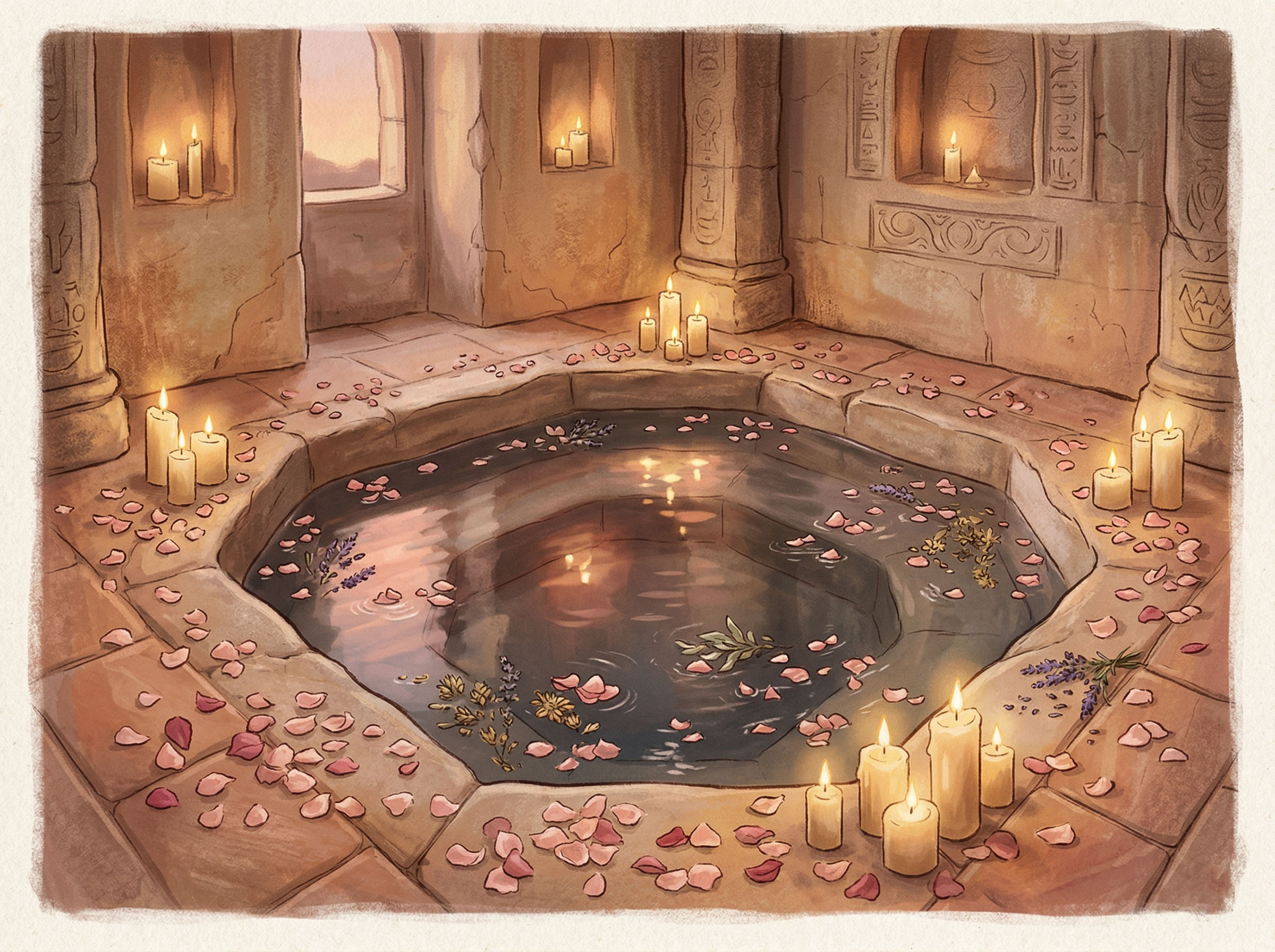
In ancient Judaism, the concept of niddah — ritual impurity during and after menstruation — is laid out in the book of Leviticus. A menstruating woman was considered ritually impure for seven days, and anything she touched shared that status. This was not a punishment but a religious framework for managing holiness and bodily states. After the period ended, a woman would immerse in a mikveh (a ritual bath) and be considered fully restored. Orthodox Jewish women continue this practice today, and many speak of it as a monthly ritual of renewal rather than shame. The distinction between religious structure and moral condemnation is an important one.
Early Christianity largely inherited the Jewish concept of menstrual impurity but applied it inconsistently. Some church fathers wrote that menstruating women should not receive communion or enter a church. Others, including Pope Gregory I in the 6th century, argued that menstruation was natural and women should not be excluded from worship because of it. This tension between restriction and acceptance never fully resolved, and local practice varied enormously across centuries and regions.
In Islam, menstruation (called hayd) also creates a state of ritual impurity. Menstruating women are excused from prayer and fasting during their period, rather than forbidden from spiritual life entirely. The Quran and Hadith treat menstruation as a natural condition requiring consideration. Historical Islamic medical scholars like Ibn Sina (Avicenna) wrote about menstruation in clinical terms, recognising it as a regular bodily process linked to reproductive health. However, modern interpretations—often influenced by cultural hate attitudes towards women rather than core texts—portray menstruation as making women "impure, dirty, or infectious." These views are frequently promoted or emphasized by certain Islamic male interpreters and have been used in ways that can contribute to the subjugation or marginalization of women.
In Hinduism, practices around menstruation varied widely by region and caste, but in many communities, menstruating women were asked to rest separately, not cook, and not enter temples. While sometimes framed as restriction, these separations were also understood by many women as periods of legitimate rest from household duties — a complex social reality that resists simple judgment from a modern distance.
Menstruation Through the Ages: A Brief Timeline
The Middle Ages: Eve's Curse and the Medical Muddle
Medieval Europe inherited the worst of classical anxiety and filtered it through Christian theology. The association of menstruation with Eve's sin — and therefore with female weakness and moral susceptibility — became deeply embedded in both medicine and church teaching. Medieval physicians, working from ancient Greek texts they did not always fully understand, continued to warn that menstruating women were dangerous to their surroundings.
Women themselves, of course, carried on. They used rags, moss, and wool to manage their periods, and washed and reused them. The word "rag" for menstrual cloth is one of the oldest colloquialisms in the English language, suggesting that even when the subject was taboo in formal writing, women talked about it practically among themselves. Midwives and community healers held knowledge about cycle irregularities and remedies that never made it into the official medical texts of the day.
One fascinating medieval idea was that menstrual blood, if it stopped flowing, would turn into milk during pregnancy and nursing — a theory that, while medically wrong, did acknowledge a real hormonal connection between menstruation and lactation that science would not properly explain until the 20th century.
✨ Did You Know?
The First Commercial Menstrual Pad Was Invented by Nurses
During World War I, nurses working in battlefield hospitals noticed that the highly absorbent cellulose bandage material — cellucotton — worked remarkably well for managing their periods. Kimberly-Clark took note, and by 1921 had released Kotex, the first mass-marketed disposable menstrual pad. The marketing team struggled enormously: most stores refused to display the product openly, so they placed a box with a slot beside the counter — women could pay without having to ask a sales clerk for it. A small act of privacy that says a great deal about 1920s attitudes.
The Victorian Era: When Medicine Made It Worse
If medieval attitudes were shaped by theology, Victorian attitudes were shaped by medicine — and the results were, in some ways, even more restrictive for women. 19th-century doctors largely agreed that menstruation was a state of physical vulnerability, and their prescriptions reflected this. Women were advised to rest completely during their periods, avoid cold water, abstain from exercise, and in some cases, be absent from school or work.
In the late nineteenth century, a small but vocal group of male physicians and psychologists argued that intellectual work during menstruation was actively dangerous. They claimed that the energy or “nerve force” spent on the brain would be diverted from the developing reproductive system, potentially damaging a woman’s ability to menstruate normally or bear children. This pseudoscientific theory was most prominently advanced by Harvard professor Edward H. Clarke in his 1873 book Sex in Education, and echoed by figures such as British psychiatrist Henry Maudsley and psychologist G. Stanley Hall. Presented with clinical confidence and backed by anecdotal case studies, it was used as a medical argument against rigorous education and co-education for women. The notion had no sound scientific basis, yet it carried significant influence in debates over women’s access to higher education.
At the same time, the Victorian era saw real medical progress. Researchers began to connect menstrual irregularities to health conditions, to study hormonal influences, and to move away from the ancient idea that periods were simply the body expelling "bad blood." The groundwork was being laid, however imperfectly, for the endocrinological understanding of the 20th century.
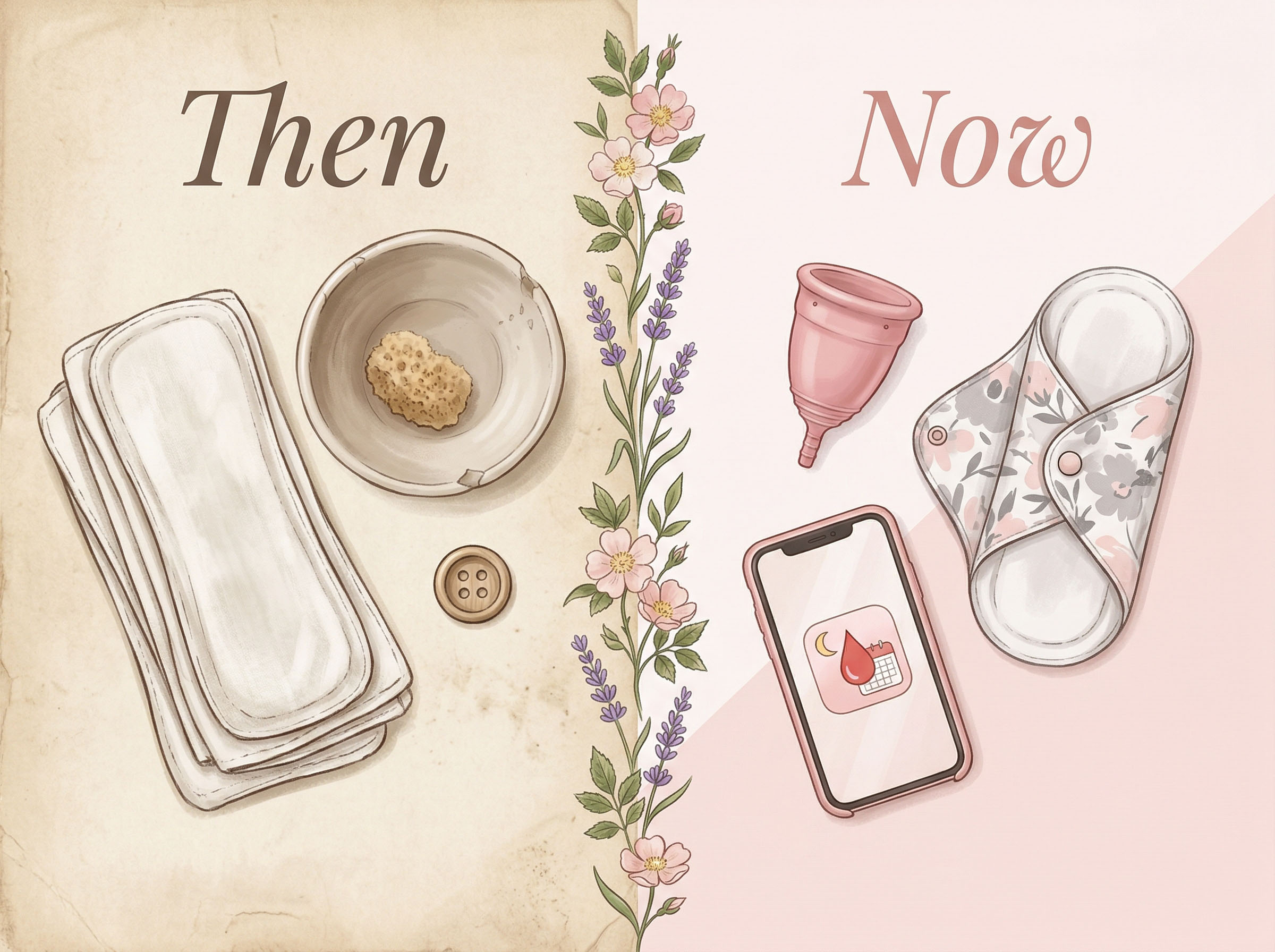
Victorian women managed their periods with reusable cotton "menstrual aprons" or belted pads held in place by a harness of sorts — cumbersome, uncomfortable, and requiring constant laundering. The sheer physical effort of managing a period before disposable products is easy to forget and worth appreciating.
The 20th Century: From Silence to Science
The invention of disposable menstrual products changed women's lives in ways that are genuinely hard to overstate. Kotex pads arrived in 1921, Tampax tampons in 1936. For the first time in history, women could manage their periods discreetly, reliably, and without the daily washing and drying of cloth materials. Participation in the workforce, in education, in sports — all became more straightforward. The practical liberation was real, even if the social conversation around periods remained awkward for decades more.
The mid-20th century brought the discovery of the hormonal cycle. Scientists identified oestrogen and progesterone, charted the four phases of the menstrual cycle (menstrual, follicular, ovulatory, and luteal), and began to understand how hormones drove not just fertility but mood, energy, immune function, and bone density. The female body was revealed as a highly sophisticated system operating in coordinated phases — not a defect or a vulnerability, but a complex and purposeful design.
Yet public conversation lagged behind science. Menstruation was not mentioned in polite company, not depicted in advertising (a blue liquid substituted for red well into the 1990s), and barely discussed in schools. Girls arriving at their first period were often entirely unprepared, a situation that reflected a cultural discomfort that science alone could not fix.
📊 By the Numbers
The Menstrual Cycle in Context
- ~450 The average number of periods a woman will have during her lifetime — roughly 38 years of menstrual cycles.
- 2,000+ Years that papyrus-based menstrual products were used in ancient Egypt — some of the earliest documented period care in history.
- 1921 Year the first mass-marketed disposable menstrual pad (Kotex) became commercially available — about 100 years ago.
- 10 yrs The approximate time it took after the hormonal cycle was first mapped (1930s–40s) before the oral contraceptive pill entered clinical trials, changing women's relationship with their cycle permanently.
Indigenous and Non-Western Traditions: A Different Relationship
Outside the indigenous European and Middle Eastern historical record, many cultures held views of menstruation that were less burdened with shame and more oriented toward natural power. In numerous Indigenous North American traditions, a girl's first period was celebrated with a coming-of-age ceremony marking her transition into womanhood — a rite of passage that acknowledged the significance of the change and set her within the community as a woman.
In some of these traditions, menstruating women were considered to be at the height of their spiritual strength, not their lowest. Separation during menstruation, where it occurred, was sometimes understood as a form of protection — of the woman herself, or of others whose activities (such as hunting) might be affected by her heightened power. These frameworks are very different from the punitive separation of women in shame-based traditions, and conflating them does a disservice to both.
In parts of sub-Saharan Africa, traditional societies marked menarche (the first period) with communal celebration and the passing of knowledge from older women to younger ones — a form of intergenerational teaching that kept feminine health knowledge alive. In Japan, the concept of kegare (impurity) applied to menstruation, but historical evidence also shows that women's quarters in imperial households were administered by women with considerable autonomy, and that cycles were tracked practically for fertility purposes with sophistication.
The Modern Era: Openness, Products, and Cycle Awareness
Today, women in much of the world have access to a remarkable range of period care options: disposable pads and tampons, reusable menstrual cups and discs, period underwear, and hormonal options that can reduce or eliminate periods entirely. Tracking apps have turned what previous generations called "counting on the calendar" into a data-rich practice, with some apps able to predict symptoms, energy levels, and mood shifts based on cycle phase.
The four phases of the menstrual cycle — menstrual, follicular, ovulatory, and luteal — are now understood to influence far more than reproduction. Research in recent decades has shown that oestrogen and progesterone affect cognitive function, physical performance, immune response, and emotional regulation in meaningful ways. Many women are using this knowledge practically: scheduling demanding work during the follicular phase when energy tends to peak, and building in recovery time during the luteal phase when the body naturally slows.
Hygiene practices have evolved accordingly. Beyond choosing a product, modern period care includes awareness of pH balance (the vagina's natural acidity changes slightly across the cycle), the importance of breathable materials, the risks of leaving products in too long, and the value of tracking irregularities that might point to underlying health considerations. A woman who understands her cycle is better positioned to notice when something changes — which is always worth a conversation with a healthcare provider.
Your Questions, Answered
What History Teaches Modern Women
Tracing the story of menstruation through history is, in the end, a study in how knowledge and fear interact. When something is not understood, it tends to be controlled, mythologised, or avoided. As understanding grows, attitudes shift — though rarely as quickly as the science itself.
For modern women, that history holds a few worthwhile insights. The practical management of periods, while genuinely transformed by modern products, sits within a very long chain of women solving the same monthly challenge with whatever their era offered. The mix of spiritual significance, social restriction, and ordinary practicality that different cultures brought to menstruation reflects something consistent: that women's bodies have always demanded attention, one way or another.
What is different now is the quality of information available. Women today can track their cycles with precision, understand the hormonal shifts behind their symptoms, and choose from a wider range of period care products than any generation before them. The conversation has become more open — in families, in schools, in public health messaging. The history of silence and shame is being actively replaced by something more useful: straightforward knowledge, passed woman to woman, as it always has been — just louder now, and better informed.
📋 In Brief
What History Teaches Us About Menstruation
- Ancient civilisations viewed menstruation through mixed lenses — practical, medicinal, sacred, and feared — often at the same time.
- World religions each developed structured approaches to menstruation, ranging from ritual rest to spiritual renewal practices still observed today.
- Medieval and Victorian attitudes were shaped by theology and flawed medical theory, which restricted women's participation in education, work, and worship.
- The 20th century brought hormonal science, disposable products, and a gradual shift toward open conversation about the female cycle.
- Many non-Western and Indigenous cultures historically treated menstruation as a marker of feminine strength, not weakness.
- Modern women have access to better information, better products, and a richer understanding of their cycles than any previous generation — a genuine shift from centuries of silence.
Disclaimer: This content is for informational and educational purposes only and does not constitute medical advice. It is not intended to be a substitute for professional diagnosis or treatment. Always consult with a qualified healthcare provider regarding any medical condition or treatment plan. Never disregard professional medical advice because of something you have read here.