日本語
日本語  Deutsch
  English
  Español
  Français
  Português



There is something quietly powerful about understanding the body you live in. Not in a clinical, detached way — but in a warm, personal, this-is-mine kind of way. Yet for many women, female anatomy remains one of the least-discussed topics of their education. School health classes covered the basics at a sprint.
Conversations at home may have been awkward or avoided entirely. And so, for a surprising number of women, the body they have inhabited their entire lives still holds unanswered questions.
This guide is here to change that — gently, honestly, and without embarrassment. Whether you are a young woman stepping into adulthood, a mother who wants to be better prepared to answer her daughter's questions, or simply a woman who never got the thorough explanation she deserved, consider this your warm, clear welcome into understanding your own anatomy.
Knowledge is not indulgent. It is practical, healthy, and frankly overdue.
The Outside: What You Can See
The external female genitalia — collectively called the vulva — is something many women have never closely examined. That might sound surprising, but it is more common than you think. The vulva includes several distinct structures, each with a purpose.
The mons pubis is the soft, rounded area of fatty tissue that sits over the pubic bone. It serves as a cushion and is covered in pubic hair after puberty. Below it, the vulva opens into two sets of skin folds: the labia majora (the outer, fuller lips) and the labia minora (the inner, thinner folds). Both vary enormously from woman to woman in size, color, and shape — and all variations are entirely normal. There is no single standard, despite what filtered images might suggest.
At the top of the labia minora, where the folds meet, sits the clitoral hood — a small fold of skin that partially covers the clitoris. The clitoris is far more than the small external tip most people are aware of. It is an internal structure that extends several inches inside the body in a wishbone shape. Only its tip, called the glans, is visible externally. The clitoris contains thousands of nerve endings — more than any other structure in the human body — and plays a central role in arousal and pleasure for most women.
Below the clitoris is the urethral opening, the small passage through which urine exits the body. This is separate from the vaginal opening, a distinction that confuses many women and even some men. Below that is the vaginal opening (also called the introitus), and behind it, the perineum — the stretch of tissue between the vaginal opening and the anus.
✦ Did You Know?
The full internal clitoris is shaped like a wishbone and can be 9–11 cm long. For centuries, medical textbooks illustrated only its external tip — the complete internal structure was not fully mapped and published until the 1990s. Many anatomy textbooks still omit it entirely.
The Inside: Your Internal Landscape
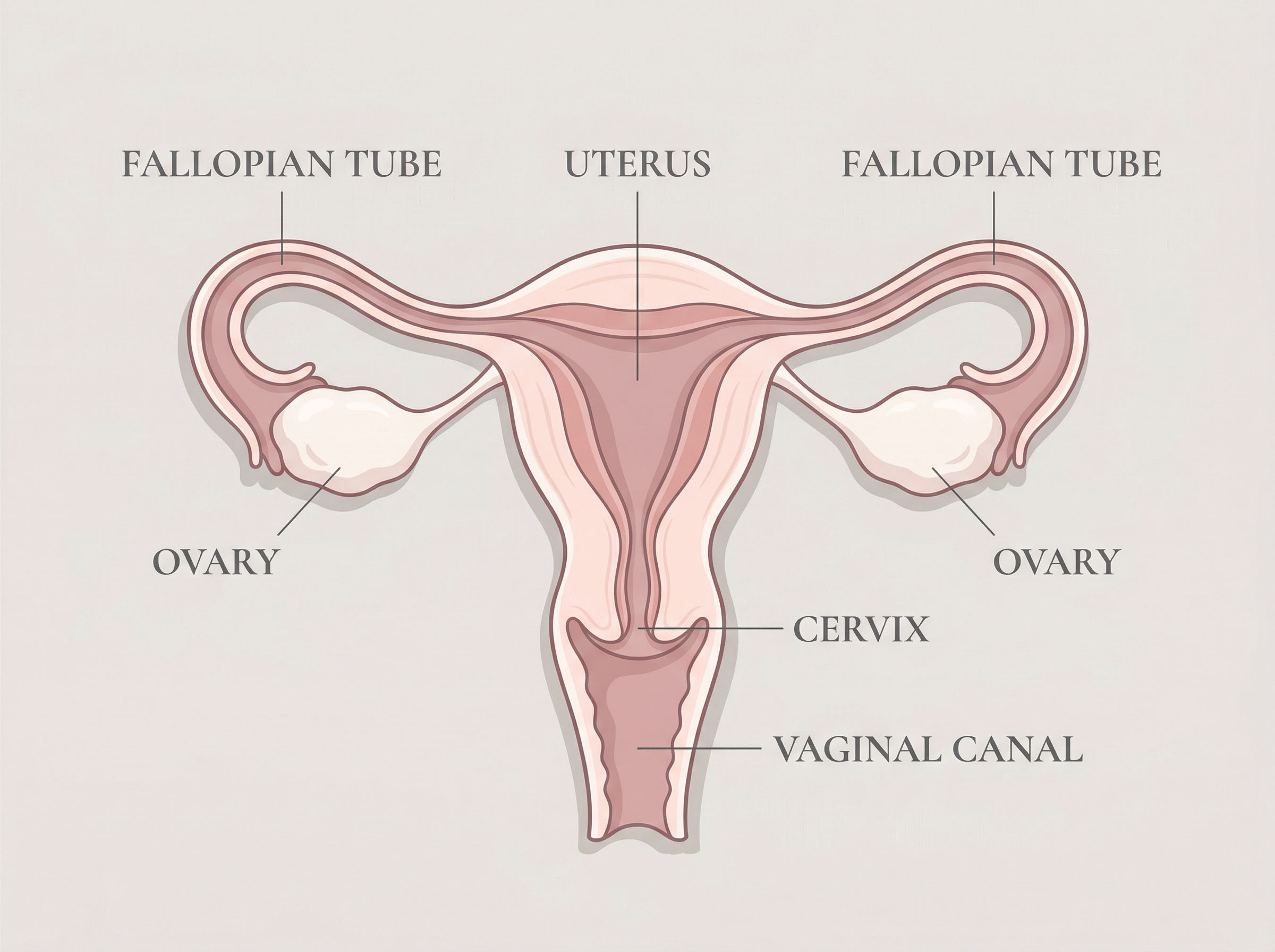
Moving inward, the vagina is a muscular, elastic canal that connects the vulva to the cervix. It is typically 7–10 cm long when at rest, though it can expand significantly — an adaptation that serves both sexual activity and childbirth. The vaginal walls are lined with a mucous membrane and, in women who have gone through puberty, naturally produce moisture that keeps the environment balanced and healthy.
At the far end of the vaginal canal sits the cervix — the lower, narrow portion of the uterus. You can think of the cervix as a gateway. It allows menstrual blood to flow out, sperm to pass through during a fertile window, and it seals itself during pregnancy to protect the uterus. The cervix changes in texture and position throughout the menstrual cycle, something women who practice fertility awareness often learn to track by touch.
The uterus is a pear-shaped, muscular organ that sits in the center of the pelvis. It is where a fertilized egg implants and a baby grows during pregnancy. Its inner lining — the endometrium — builds up each cycle and sheds during menstruation if pregnancy does not occur. The uterus is attached to two fallopian tubes, one on each side, which extend toward the ovaries. Each month, a mature egg is released from one of the ovaries, travels through a fallopian tube, and either meets a sperm or is naturally absorbed by the body.
The ovaries are also hormone producers. They release estrogen and progesterone — the two primary female sex hormones — which regulate the menstrual cycle, support bone density, affect mood, skin, and libido, and play a central role in reproductive life from puberty through menopause.
The Rhythm of the Body: Your Menstrual Cycle
The menstrual cycle is one of the most misunderstood aspects of female physiology — and one of the most fascinating once you actually look at it. Far from being simply "that time of the month," the menstrual cycle is a sophisticated hormonal system that influences energy, mood, skin, libido, and cognition across the entire month.
A typical cycle runs anywhere from 21 to 35 days, with 28 days being the commonly cited average. It is divided into four phases:
✦ The Four Phases of the Menstrual Cycle
| Phase | Approximate Days | What Happens | How You May Feel |
|---|---|---|---|
| Menstrual | Days 1–5 | The uterine lining sheds; menstrual bleeding occurs. | Tired, introspective, sometimes crampy; energy is lower. |
| Follicular | Days 1–13 | Estrogen rises; follicles in the ovaries mature; uterine lining rebuilds. | Energy returns, mood lifts, focus sharpens. |
| Ovulatory | Day 14 (approx.) | A mature egg is released from an ovary; peak fertility window. | Confident, social, libido often at its highest. |
| Luteal | Days 15–28 | Progesterone rises; the body prepares for possible pregnancy or the next period. | Slower, more inward-focused; PMS symptoms may appear in the final days. |
Tracking your cycle — even simply marking the first day of your period on a calendar — can reveal patterns that help you plan, understand your moods, and notice early if something changes. Apps, paper charts, or a basic journal all work equally well. The goal is awareness, not perfection.
“Far from being simply 'that time of the month,' the menstrual cycle is a sophisticated hormonal system that influences energy, mood, skin, libido, and cognition across the entire month.”
— Lexi Pierce, Know Yourself
Arousal, Desire, and How Your Body Responds
Understanding desire and arousal is just as important as understanding anatomy — and the two are deeply connected. For women, arousal is rarely as straightforward as it is often portrayed. It is a layered response involving the brain, the nervous system, emotions, context, and the body's physical structures.
When a woman becomes aroused, blood flow increases to the genitals, the vagina produces natural lubrication, the labia swell slightly, and the clitoris becomes engorged — similar in mechanism to a male erection. The vagina also lengthens and widens in a process called vaginal tenting, preparing the body for potential intercourse. This entire sequence can take anywhere from a few minutes to considerably longer depending on the individual, her emotional state, and the circumstances.
It is worth noting that desire and arousal do not always arrive at the same moment. Many women experience what researchers call responsive desire — arousal that follows physical or emotional stimulation rather than preceding it. This is completely normal and does not indicate anything is "wrong." It simply means that for many women, the body responds once engagement begins, rather than leading with a spontaneous urge. Understanding this distinction can relieve a great deal of unnecessary worry for women and their partners.
The clitoris, as mentioned, is the primary center of pleasure for most women. Direct stimulation of the clitoral glans — or indirect stimulation through the vaginal front wall (an area often called the G-spot, which is thought to be the internal root of the clitoral structure) — is the most common pathway to orgasm for the majority of women. Studies consistently find that the majority of women do not reach orgasm from vaginal penetration alone, which is not a dysfunction — it is simply anatomy doing what it does.
✦ Cultural Insight
A Long History of Silence
For most of Western history, female anatomy was studied and described almost exclusively by men, who pioneered the field of medicine. This was often done through the lens of male anatomy as the default, owing to the scarcity of female cadaver donations. The clitoris was noted in early Greek texts but then largely disappeared from medical literature for centuries.
It was not until the late 20th century that researchers began producing detailed anatomical maps of the full clitoral structure. Many textbooks even today include only a partial illustration. Cultural silence around female anatomy has had real consequences for women's health literacy — and for medical care.
Global & Cultural Insights / Women's History
First Experiences, Consent, and What to Expect
For young women approaching their first sexual experiences, or for women helping their daughters prepare for that stage of life, honest information matters. The cultural narrative around a woman's "first time" is often cluttered with myths, unrealistic expectations, and unnecessary anxiety.
A few things worth knowing clearly:
The hymen is a thin, flexible membrane that partially covers the vaginal opening in many girls and women. It does not "break" as many believe — it is typically a ring or crescent of tissue with a natural opening, and it stretches gradually with physical activity, the use of tampons, gynecological exams, and yes, sexual activity. The presence or absence of a hymen is not a reliable indicator of virginity, despite longstanding myths to the contrary. Gynecologists have confirmed this for decades.
First intercourse may or may not involve minor discomfort. If there is pain, it most often stems from insufficient lubrication, anxiety causing muscle tension, or moving too quickly. Discomfort is not inevitable or required. Communication with a partner, adequate preparation, and taking one's time all make a meaningful difference.
On consent: this is not a complicated concept, even if conversations around it sometimes make it seem so. Consent is a clear, enthusiastic, ongoing agreement between adults. It can be given and it can be withdrawn — at any point, for any reason. No one is owed sexual access to another person's body, regardless of circumstances. Teaching daughters these principles from a young age — framed as their body belonging to them and their right to say yes or no — builds a lifelong foundation of healthy self-respect. Additionally, daughters should be taught to request an STI test from any partner before engaging in sexual intercourse and to use protection every time. A simple test can protect your daughter’s life, and there is no shame in asking for or taking one.
Common Questions Women Ask About Their Bodies
Sexual Health: The Basics Every Woman Should Know
Sexual health is not a separate category from overall health — it is part of it. And staying informed is one of the most straightforward things a woman can do for herself at any age.
Regular gynecological exams are a cornerstone of women's health. A typical well-woman exam includes a pelvic exam, breast exam, blood pressure check, and discussion of any concerns. Cervical screenings (commonly called Pap smears or Pap tests) check for abnormal cells that could indicate HPV infection or, over time, the early stages of cervical cancer. Guidelines vary by age and health history, so asking your healthcare provider what schedule makes sense for you is the best approach.
Sexually transmitted infections (STIs) are far more common than most people realize and are not a reflection of character or lifestyle — they are a health issue like any other. Many STIs have no symptoms and can only be detected by testing. If you are sexually active with multiple partners, you are already making the first mistake: potentially getting an STI or spreading it to an innocent person. Asking for STI testing with a new partner is simply responsible health management. Most STIs are straightforward to treat when caught early. Don’t risk your life or lifelong health problems for one sexual encounter. Always request an STI test — and if there isn’t one, walk away.
Natural vaginal pH is mildly acidic (around 3.8–4.5), and this acidity protects against infection by keeping harmful bacteria in check. Using scented soaps, douches, or heavily fragranced products inside or directly on the vulva can disrupt this balance and lead to irritation or infections like bacterial vaginosis. The vagina is self-cleaning; warm water is all that is needed externally.
The pelvic floor deserves a mention here too. These muscles form a kind of hammock at the base of the pelvis, supporting the uterus, bladder, and bowel. They play a role in bladder control, sexual sensation, and recovery after childbirth. Pelvic floor exercises — contracting and releasing these muscles regularly — are one of the most useful, zero-equipment habits a woman can build, at any age.
✦ Quick Health Reminders
- Schedule a well-woman exam annually, or as recommended by your provider.
- Cervical screenings (Pap tests) typically begin at age 21.
- Only the external vulva needs washing — the vagina is self-cleaning.
- Pelvic floor exercises take less than five minutes a day and benefit women at every life stage.
- Any unusual pain, discharge, bleeding between periods, or discomfort during intercourse is worth discussing with a healthcare provider — not ignoring.
- STI testing is a normal part of responsible sexual health, not something to feel embarrassed about requesting.
Pleasure Is Part of the Conversation, Too
It would be incomplete to discuss female anatomy without acknowledging that the female body is also designed for pleasure — and that this is not a controversial statement. The clitoris has no reproductive function. Its only known purpose is sensation. That is not an accident of nature; it is a feature worth understanding and not being embarrassed about.
For generations, women's pleasure was either ignored in health education or treated as secondary — an afterthought to reproduction or to a partner's experience. The result is that many women reach adulthood without a clear understanding of what their own body responds to, what they enjoy, or even that personal exploration is a normal and healthy part of self-knowledge.
Understanding your body — what creates comfort, what creates tension, what feels good and what does not — is not indulgent. It is genuinely useful. Women who know their own bodies are better able to communicate with partners, recognize when something feels wrong, and approach intimacy with confidence rather than anxiety.
Pleasure is not the whole of sexual health, but it is a legitimate part of it. And a woman who understands her anatomy is simply better equipped — for her own sake.

A Note for Mothers: Starting the Conversation
If you are a mother reading this — perhaps you came here not for yourself, but because you want to be ready when your daughter starts asking questions — that instinct is exactly right. The research on this is consistent: girls whose mothers talk openly with them about bodies, cycles, and health grow up with better health outcomes, higher self-esteem, and healthier relationships.
You do not need to deliver one grand, comprehensive talk. That kind of pressure rarely produces the best conversations anyway. Small, natural moments work far better: answering a question honestly when it arises, using the correct names for body parts from an early age, responding calmly to a question about a tampon under the bathroom sink, talking through what to expect before a daughter's first period arrives.
If you did not receive much of this yourself — if your own mother was silent or awkward on these topics — that is common. And it means you may need to educate yourself before you can educate your daughter. That is perfectly fine. Articles like this one are a reasonable starting point. Your family doctor is another. The important thing is not to wait until a daughter is searching for answers in less reliable places.
Normalizing the female body — its functions, its changes, its needs — is one of the quieter gifts a mother can give. It costs nothing and lasts a lifetime.
✦ In Brief — What This Article Covered
- Vulva vs. vagina: The vulva is the external anatomy; the vagina is the internal canal — they are distinct.
- The clitoris is a large internal structure (not just its visible tip) with the highest concentration of nerve endings in the body.
- The menstrual cycle has four phases, each affecting energy, mood, and libido differently.
- Responsive desire — arousal following stimulation rather than preceding it — is normal for many women.
- The hymen is flexible tissue with a natural opening; it does not indicate virginity.
- Consent is a clear, ongoing, enthusiastic agreement that can be withdrawn at any time.
- Vaginal pH is naturally protective; harsh soaps and douching disrupt it.
- Pelvic floor exercises support bladder control, sexual sensation, and post-birth recovery.
- Mothers who talk openly about bodies raise daughters with better health outcomes and confidence.
Your Body, Your Knowledge
Understanding your own anatomy is not a luxury or an indulgence. It is foundational. The women who know their bodies — who can name what they're feeling, track what is normal for them, and speak confidently with a doctor or a partner — are simply better positioned in nearly every dimension of health and wellbeing.
This is not about perfection. It is not about meeting any particular standard. It is about something far more personal: knowing yourself. Your body has been doing extraordinary things since before you were born. The least it deserves is your honest attention.
Start wherever you are. Ask questions. Read. Talk to your doctor. Use the correct words — with yourself, with your daughters, with your partners. The conversation gets easier every time you have it.
And the knowledge? It turns out, it was always worth having.
Disclaimer: This content is for informational and educational purposes only and does not constitute medical advice. It is not intended to be a substitute for professional diagnosis or treatment. Always consult with a qualified healthcare provider regarding any medical condition or treatment plan. Never disregard professional medical advice because of something you have read here.