日本語
日本語  Deutsch
  English
  Español
  Français
  Português



Walk into any high-end grocery store, airport terminal, or local coffee shop on a Tuesday morning, and you will see it. It isn't a flash of skin or a plunging neckline. Instead, it is a deliberate, tight-fit architectural choice.
We are living in the era of the "activewear aesthetic," where the fabric is so thin and the fit so precise that the female anatomy is no longer a suggestion, but a focal point. Specifically, the "camel toe"—once a source of frantic wardrobe checks and social embarrassment—has been rebranded. It has become the "cleavage" of the 2020s.
To understand how we got here, we have to look back. Fashion has always had a "zone of focus." In the 1950s, the focus was the bust. The "Bullet Bra" and the cinched waist created a hyper-feminine silhouette that signaled health, maturity, and traditional allure. By the 1990s, the "Wonderbra" and the rise of the supermodel took that same focus and dialed it up to an extreme. Cleavage was the ultimate accessory. It was the way a woman signaled her presence in a room.
Today, the focus has shifted downward. As yoga pants and technical leggings have replaced denim as the default uniform for women of all ages, the "intimate zone" has taken center stage. This isn't just about comfort; it is a shift in how women use their bodies to signal status, health, and a specific type of modern femininity.
The Engineering of the "Intimate Zone"
If you look at the construction of modern leggings, the design is no accident. In the early 2000s, athletic wear was baggy. You wore oversized cotton T-shirts and loose shorts to the gym. But as the "athleisure" industry exploded into a multi-billion-dollar market, the engineering changed. Brands began using high-compression fabrics, four-way stretches, and removed the "gusset"—the diamond-shaped piece of fabric designed to prevent pulling in the crotch area.
The result? A fit that hugs every curve of the labia. While some might call it a wardrobe malfunction, a quick scroll through social media or a trip to a trendy Pilates studio suggests otherwise. Many women are now choosing gear specifically because it accentuates this area. There are even "seam-free" leggings designed to create a smoother, yet more pronounced, look.
For many younger women, showing the labia through clothing is seen as a badge of athleticism. It suggests that her body is so toned, and her clothing so high-performance, that there is nothing to hide. It is the visual shorthand for "I am active, I am fit, and I am comfortable in my skin." Much like the 1950s housewife took pride in her groomed appearance and structured silhouette, the modern woman takes pride in a body that looks "sculpted" by the gym, and she isn't afraid to show the results of that labor.
The term "athleisure" didn't exist in popular culture until the late 2010s. For nearly a century, athletic clothing was prioritized for loose movement. The shift to ultra-compression, single-panel fabrics is a relatively recent, engineered phenomenon that creates the "second-skin" silhouette we see today.
The Psychology of Attention
Why has this become the go-to look? For some women, it is about the simple reality of what is available. If every major brand sells "second-skin" leggings, that is what women will wear. But for many others, there is an undeniable element of attention.
In a world where visual competition is at an all-time high, women are finding new ways to stand out. The bust has been the focus for decades; it’s "old news." The midriff had its moment in the early 2000s with low-rise jeans. The "booty" had a massive surge over the last ten years. The "front-and-center" focus on the labia feels like the final frontier of the female form in public spaces.
There is a certain thrill in the "accidental" nature of it. When a woman wears leggings that accentuate her intimate area, she can claim she is just being practical for her workout. Yet, the biological reality is that it draws the eye. Men notice it, other women notice it, and the wearer knows it is being noticed. It creates a tension between the "wholesome" image of a woman going to the gym and the "provocative" nature of the garment itself.
This mirrors the 1950s "sweater girl" look. It was modest—the necklines were often high—but the tightness of the knitwear left nothing to the imagination regarding the shape of the bust. Today’s leggings do the exact same thing for the lower half of the body. It is a way to be provocative while remaining fully "covered."
| Era | Focus Zone | Key Garment | Cultural Signal |
|---|---|---|---|
| 1950s | Bust | Bullet Bra | Mature Traditional Allure, Sophistication |
| 1990s | Bust | Wonderbra | Overt Presence, Visual Power |
| 2000s | Midriff | Low-Rise Jeans | Casual Torso Focus, Rebellious Ease |
| 2010s | Buttocks | Glute-Contouring Pants, Skinny Jeans | Emerging Fitness Focus, Shape Display |
| 2020s | Intimate Zone (Labia) | High-Compression Activewear | Raw Physical Condition, Organic Honesty |
The Three Minute Metric
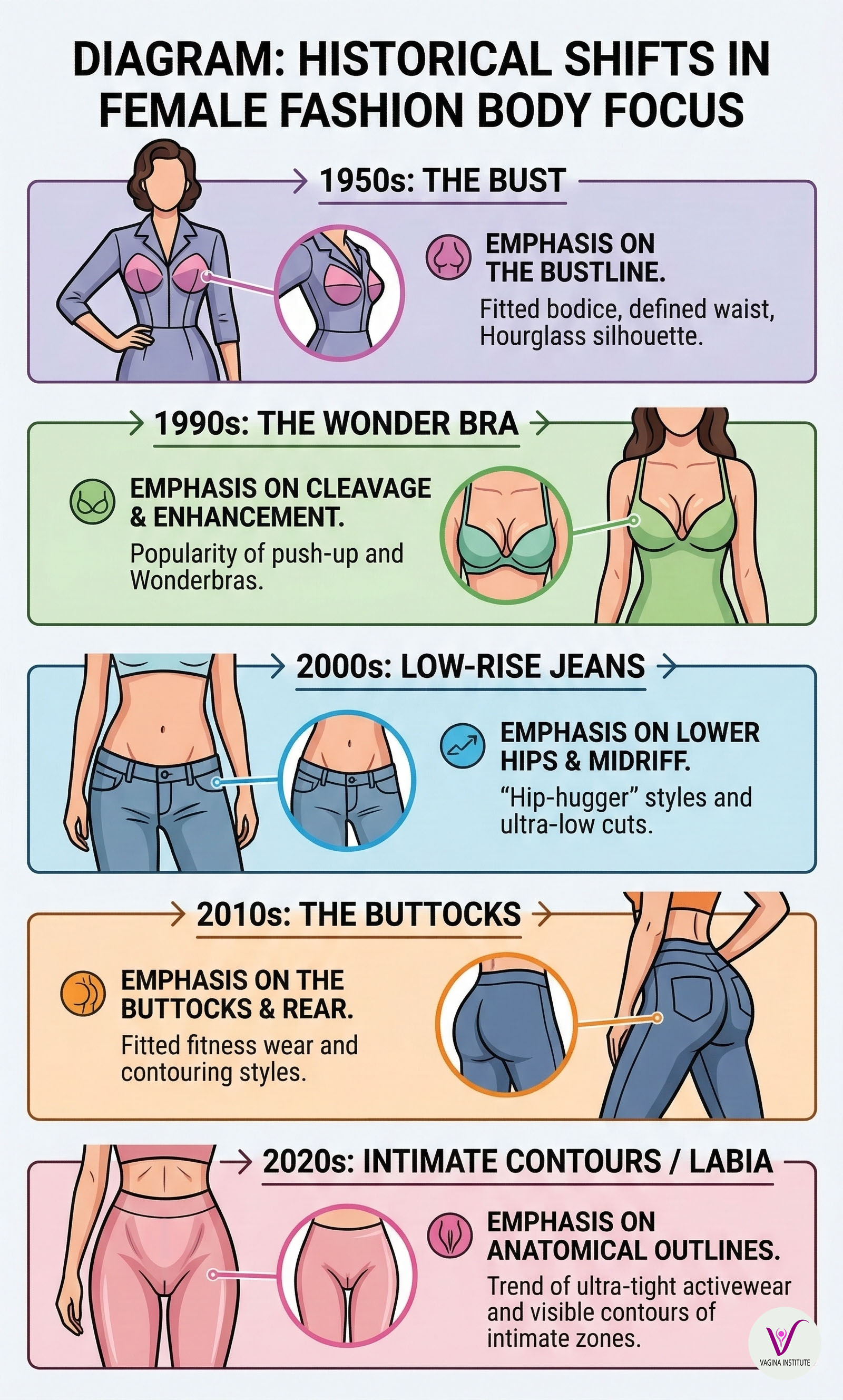
From the structured silhouettes of the 1950s to the anatomical honesty of today, the "zone of focus" continues to evolve with the female identity.
A Return to the Physical
From a cultural analyst’s perspective, this trend might actually be a reaction against the digital world. We spend so much time behind screens, looking at filtered images, that there is a growing desire for something "real" and "raw." The labia is perhaps the most honest part of the female anatomy. By accentuating it, women are grounding themselves in their biological reality.
In a traditional sense, the celebration of the female body has always been linked to its potential and its power. While modern discourse often tries to strip away the differences between men and women, fashion has a funny way of bringing them back. You don’t see men walking around in gear that accentuates their anatomy in the same way—at least, not in a way that is socially celebrated. This trend is uniquely female. It is a celebration of the softness and the specific curves that define womanhood.
"By accentuating it, women are grounding themselves in their biological reality... It is a celebration of the softness and the specific curves that define womanhood."
Many women report feeling "liberated" by this. Not in a political sense, but in a personal one. There is a relief in stopping the constant checking of mirrors to see if a seam is "too high." By leaning into the look, women are reclaiming a part of themselves that was previously deemed "too much" for public viewing. They are saying, "This is my body, this is how it fits in these clothes, and I’m not going to apologize for it."
The Social Divide
Of course, not everyone is a fan. There is a generational divide that cannot be ignored. Older women, raised in an era where "modesty" was a primary virtue, often find the trend jarring. They see it as a lack of decorum or a sign of "oversharing." To them, the "intimate zone" is called that for a reason—it is meant to be private.
However, younger women view it through the lens of honesty. They see the "smooth front" of 1990s pantyhose as a lie. They prefer the truth of the body. This shift represents a move away from the "plastic" perfection of the past and toward a more "organic" femininity. It is a femininity that isn't afraid to be seen as a physical, biological entity.
The Role of Traditional Femininity
Historically, a woman's vitality was often displayed through sophisticated adornment. Today, physical strength and a sculpted form are the new benchmarks of status and feminine health. The visibility of the labia is a powerful visual shortcut suggesting peak condition, requiring no additional embellishment.
While the trend may seem "edgy," it actually fits within a very traditional framework of female competition and display. Women have always used fashion to signal their health and fertility. In the 1950s, a well-defined bust and waist signaled a woman who was "ready" for her role as a wife and mother. Today, the "athletic labia" signals a woman who is in peak physical condition. It is a high-status signal that says, "I have the time to work out, and the confidence to show the world exactly who I am."
The role models of today are no longer the waif-like figures of the 90s. They are "Amazonian" women—strong, thin and curvy, and unashamedly female. They embrace their roles as the "fairer sex" while showing a level of physical grit that previous generations might have hidden. The "camel toe" is just the latest chapter in this long history of women finding ways to be seen.
Reader Q&A: The Intimate Silhouette Analysis
What’s Next?
Fashion is a pendulum. Eventually, the cycle will swing back toward loose-fitting clothes and hidden silhouettes. We are already seeing the rise of "wide-leg" lounge pants and "baggy" street style. But the impact of the "legging era" will remain. It has fundamentally changed the "baseline" of what is acceptable to show in public.
We have moved the needle. What was once considered "obscene" is now "lifestyle." What was once "too much" is now "just right." As women continue to balance their roles as professionals, mothers, and athletes, their clothing will continue to reflect that reality.
The "intimate silhouette" isn't going anywhere. It is a celebration of the female form in its most basic state. Whether it is for the attention of men, the admiration of other women, or a simple sense of personal pride, the modern woman has decided that she is done hiding. She is front and center, labia and all, and she is perfectly happy with the view.
Disclaimer: This content is for informational and educational purposes only and does not constitute medical advice. It is not intended to be a substitute for professional diagnosis or treatment. Always consult with a qualified healthcare provider regarding any medical condition or treatment plan. Never disregard professional medical advice because of something you have read here.