日本語
日本語  Deutsch
  English
  Español
  Français
  Português



The way we share our lives with a partner often feels like a private language, spoken in the hushed tones of our own homes. Yet, the dialect of that language is frequently written by the cultures that raised us. In the East, specifically within the sprawling traditions of China, Japan, Korea, and Southeast Asia, intimacy is rarely a loud declaration or a public display.
Instead, it is a steady, quiet devotion rooted in duty, family stability, and the unspoken needs of the other. By looking at how Asian women view the bonds of the heart compared to their Western counterparts, we see a fascinating study in how tradition shapes the way we love and remain loyal to the men in our lives.
The Big Picture
A Foundation of Shared Duty
At the core of the female experience, regardless of geography, lies a desire for security and a stable home for children. While modern media often focuses on the fleeting spark of romance, women globally still look for a partner who is a provider and a protector. This universal thread connects a mother in Seoul to a mother in Chicago. However, the East and West differ significantly in how they define the success of a relationship.
In many Asian cultures, intimacy is not merely an emotional or physical exchange between two individuals; it is a pillar that supports the entire family structure. Stability is valued over individualistic passion. This creates a unique form of closeness where a woman’s devotion to her husband and her children is seen as her highest calling. The "Big Picture" of Asian intimacy is one of endurance and the collective good, where the strength of a marriage is measured by the peace and prosperity of the household rather than the intensity of a single moment.
How Behaviors Vary Around the World
From Words to Deeds
Western culture, particularly in the United States and Europe, places a high premium on verbal communication. Women are encouraged to "speak their truth" and expect "I love you" to be a daily ritual. Intimacy is often equated with transparency—sharing every thought, fear, and desire.
Contrast this with the traditional Asian approach, where "doing" carries far more weight than "saying." In Japan or China, a husband may never tell his wife he loves her in the way an American husband might, yet his devotion is expressed through the tireless hours he works to provide. Similarly, an Asian wife shows her intimacy through the preparation of specific meals, the meticulous care of the home, and the support she offers her husband’s career and social standing.
- East Asia (China, Japan, Korea): Intimacy is often "high-context." This means meaning is found in what is not said. A woman understands her husband’s affection by his presence and his provision. Silence is not a sign of distance, but of comfort and mutual understanding.
- Southeast Asia (Thailand, Vietnam, Philippines): While there is more outward warmth here, the focus remains heavily on the "we" instead of the "me." Respect for the man as the head of the household is a cornerstone of romantic life, creating a structured but deeply secure environment for women.
- The West: Intimacy is "low-context." Everything must be labeled, discussed, and analyzed. While this can lead to emotional clarity, it can also lead to conflict when expectations are not vocally met.
| Feature | Asian Perspective | Western Perspective |
|---|---|---|
| Primary Expression | Acts of Service | Verbal Affirmation |
| Conflict Style | Indirect / Saving Face | Direct / Confrontational |
| Family Role | Multigenerational Focus | Nuclear / Individual Focus |
| Role of the Man | Provider & Authority | Partner & Co-equal |
Comparative analysis of cultural expressions of intimacy and domestic roles.
"A traditional Asian wife protects her husband’s dignity in public as a profound act of intimacy, building a shield around the marriage that outsiders cannot penetrate."— Amara Leclerc
History, Religion, and Social Systems
The Roots of Reserved Love
The differences we see today are not accidental; they are the result of centuries of philosophical and religious influence. In the East, Confucianism has played a massive role in defining the roles of men and women. This philosophy emphasizes hierarchy, filial piety, and the idea that a woman’s virtue is found in her ability to maintain a harmonious home.
This isn't about "oppression" in the way modern political movements might suggest; rather, it’s about a functional social order. When a woman respects her husband’s authority and he, in turn, takes on the full weight of responsibility for the family’s survival, a natural balance is achieved. This traditional structure provides a clear roadmap for intimacy. You don't have to guess your role; you live it.
Parenting & Family Dynamics: Traditional vs. Modern Perspectives
| Feature | Traditional Asian Approach | Modern Individualist Approach |
|---|---|---|
| Core Value | Filial Piety: Children are taught to honor and care for parents as a lifelong duty. | Self-Actualization: Children are encouraged to find their own path and personal happiness. |
| Mother's Role | The "Tiger" Heart: Fierce devotion to education and moral character; the emotional anchor. | The Supportive Guide: Focused on self-esteem, creativity, and emotional expression. |
| Father's Role | The Pillar: The ultimate authority and provider; respect is earned through sacrifice. | The Active Participant: Shared domestic duties and a focus on being a "friend" to children. |
| Discipline | Constructive Shame: Using social and family expectations to guide behavior and honor. | Positive Reinforcement: Using praise and rewards to build confidence and autonomy. |
| Success Metric | Stability: A child who contributes to the family legacy and provides security in old age. | Passion: A child who follows their dreams and achieves independent satisfaction. |
Table: Comparative analysis of cultural parenting frameworks.
In Western history, the rise of the individual during the Enlightenment shifted the focus of marriage from a social contract to a search for a soulmate. While this brought a new kind of romantic joy, it also brought a fragility to the home. In the East, the religious influences of Buddhism and Shintoism also promote a sense of "selflessness." The "ego" is something to be managed, not celebrated. Therefore, intimacy becomes less about "what am I getting?" and more about "how is our family doing?"
Micro-Cultural Clues
Small Behaviors That Reveal Big Values
If you were to walk into a home in Singapore or a village in rural Vietnam, you would see intimacy in the smallest of gestures. These micro-signals tell the story of a culture that values the man’s role and the woman’s quiet influence.
- The Art of the Meal: In many Asian homes, the best portions of food are still reserved for the husband and the elders. This is not a sign of the woman’s unimportance, but a sign of her power as the "nurturer-in-chief." By honoring the man, she sets a tone of respect for the children to follow.
- Saving Face: A traditional Asian wife will rarely criticize her husband in front of others. Protecting his dignity in public is a profound act of intimacy. It builds a shield around the marriage that outsiders cannot penetrate.
- Physical Touch in Private: In public, Asian couples may seem stoic or even distant. There is little hand-holding or kissing. This creates a sharp boundary between the public world and the private world. The physical connection is saved strictly for the home, making it a sacred, exclusive bond that belongs only to the couple.
- The Gift of Fruit: It is a common joke among children of Asian immigrants that their mothers don’t say "sorry" or "I love you"—they simply bring a plate of sliced fruit to your room. This carries over into marriage. A wife peeling a pear for her husband is a deep gesture of reconciliation and care.
- Managing the Finances: While the man is the face of the family and the primary earner, the wife in many Asian cultures (especially in Japan and the Philippines) is the "Chancellor of the Exchequer." She manages the household budget. This trust is a form of intimacy that shows the man relies on her wisdom and judgment to secure their future.
Visualizing the Circle of Security
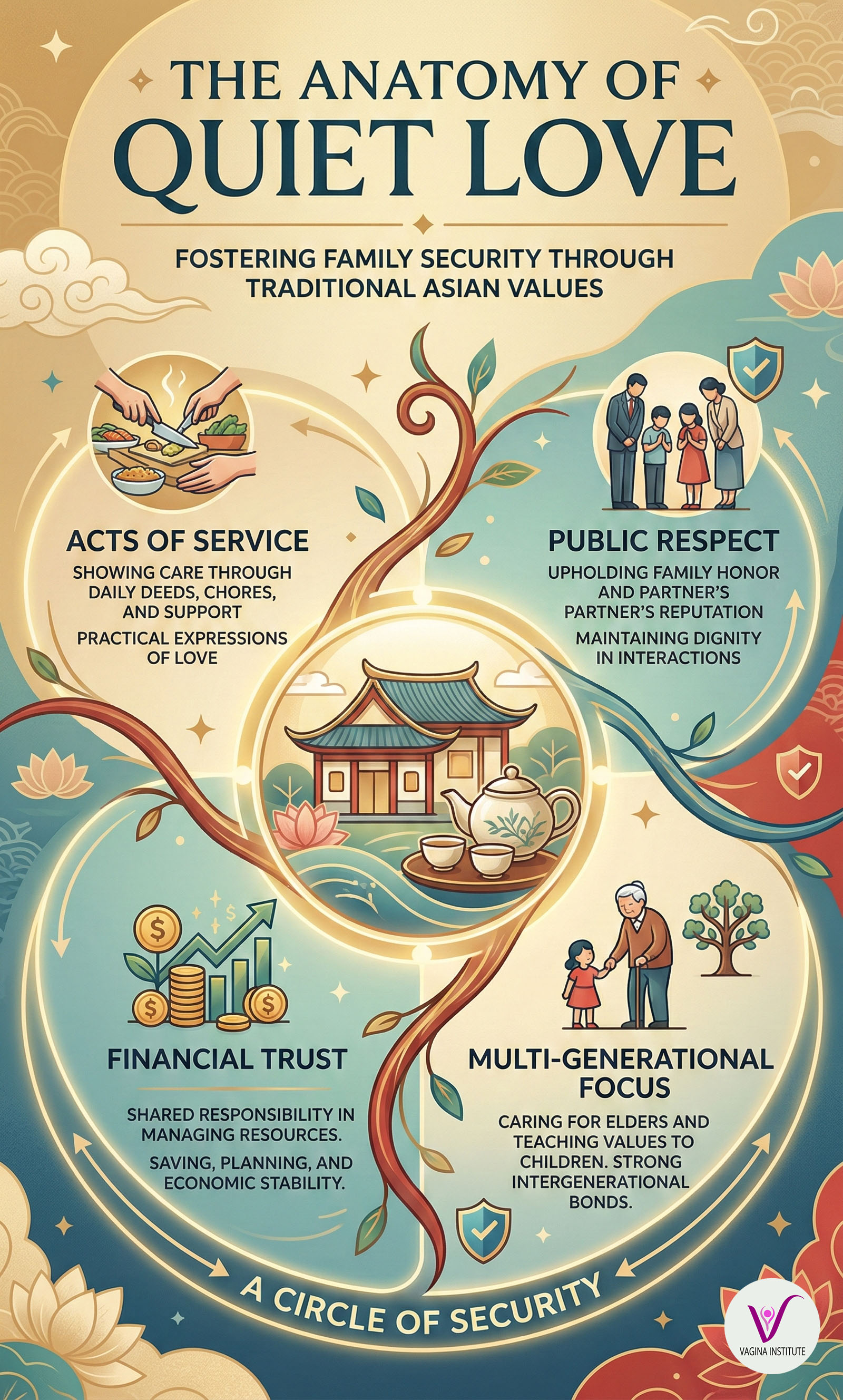
Traditional values create a structured environment where intimacy is expressed through stability and mutual respect.
Common Questions on Cultural Intimacy
The Enduring Heart of the Home
Understanding these Asian perspectives allows us to see that there is more than one way to build a successful, loving life with a man. While Western media often pushes a narrative of loud, demanding, and self-centered "empowerment," the traditional Asian model offers a different kind of strength—one found in grace, duty, and the preservation of the family unit.
For the modern woman, there is much to learn from this. We see that intimacy does not always require a constant stream of words. It can be found in the quiet routine of a well-kept home, the shared goal of raising children with character, and the steady respect shown to a husband who carries the burdens of the world on his shoulders. By embracing the idea that our roles as wives and mothers are not just personal choices but cultural contributions, we find a deeper sense of purpose.
The Asian perspective reminds us that the most resilient bonds are those built on the foundation of the "we." When a woman leans into her natural feminine strengths—patience, nurturing, and a quiet, steady loyalty—she creates a home that acts as a sanctuary. In the end, the global womanhood we all share is defined by the love we give and the families we build. Whether expressed through a plate of fruit or a heartfelt conversation, the goal remains the same: a life of meaning, shared with the man we have chosen to stand beside.
Quick-Start: Applying Cultural Wisdom
The Do's
- Observe: Look for the silent ways your husband provides.
- Honor: Speak highly of him in front of your children.
- Nurture: Use small acts of service (like a favorite meal) as a peace offering.
The Don'ts
- Over-Analyze: Don't assume silence equals distance.
- Public Critique: Avoid correcting your husband in social settings.
- Expect "Western" Scripts: Don't force verbal validation if his "language" is action.
Disclaimer: This content is for informational and educational purposes only and does not constitute medical advice. It is not intended to be a substitute for professional diagnosis or treatment. Always consult with a qualified healthcare provider regarding any medical condition or treatment plan. Never disregard professional medical advice because of something you have read here.