English
  Español
  Português



There's a particular kind of exhaustion that women carry that doesn't show up on a sleep tracker. It's the weight of showing up — for your kids, your job, your home, your relationships — while quietly managing a dozen invisible things that nobody ever puts on a to-do list. Emotional labor. Old grief. The mental chatter that starts the second your alarm goes off.
Emotional balance isn't a personality trait some women are born with and others aren't. It's something you build, bit by bit, through the things you do every day. And the good news is that the activities that work best aren't all serious or clinical. Some of them are joyful. Some are physical. And yes, one of them is deeply personal — and absolutely counts.
Here are eight activities that genuinely help women restore and maintain emotional balance, backed by a growing body of research and the lived experience of women who have put them to work.
Emotional balance isn't something you find. It's something you practice — one honest, intentional activity at a time.
— Sienna Duarte1. Get Outside and Move Your Body
It sounds almost too simple to be worth mentioning, but the combination of movement and outdoor exposure is one of the most well-documented tools for emotional regulation that exists. A walk outside — not a podcast walk, not a phone-in-hand walk, but an actual eyes-open, air-on-your-skin walk — does something measurable to your stress chemistry.
When you move, your body releases endorphins and reduces circulating cortisol. When you're outside, natural light helps regulate your circadian rhythm, which has a downstream effect on mood and anxiety. Research published in journals like Environmental Health and Preventive Medicine has found that spending even 20 minutes in a natural setting significantly lowers cortisol levels.
You don't need to run a 5K. A brisk walk around the block, a hike with a friend, a slow loop through the park with a stroller — all of it counts. The key is that the movement happens, and you're present for it.
✦ Try This At Home
Commit to a 20-minute outdoor walk three times a week for two weeks. Leave the headphones behind at least twice. Notice what changes in your mood and your thinking — most women report a measurable shift by day ten.
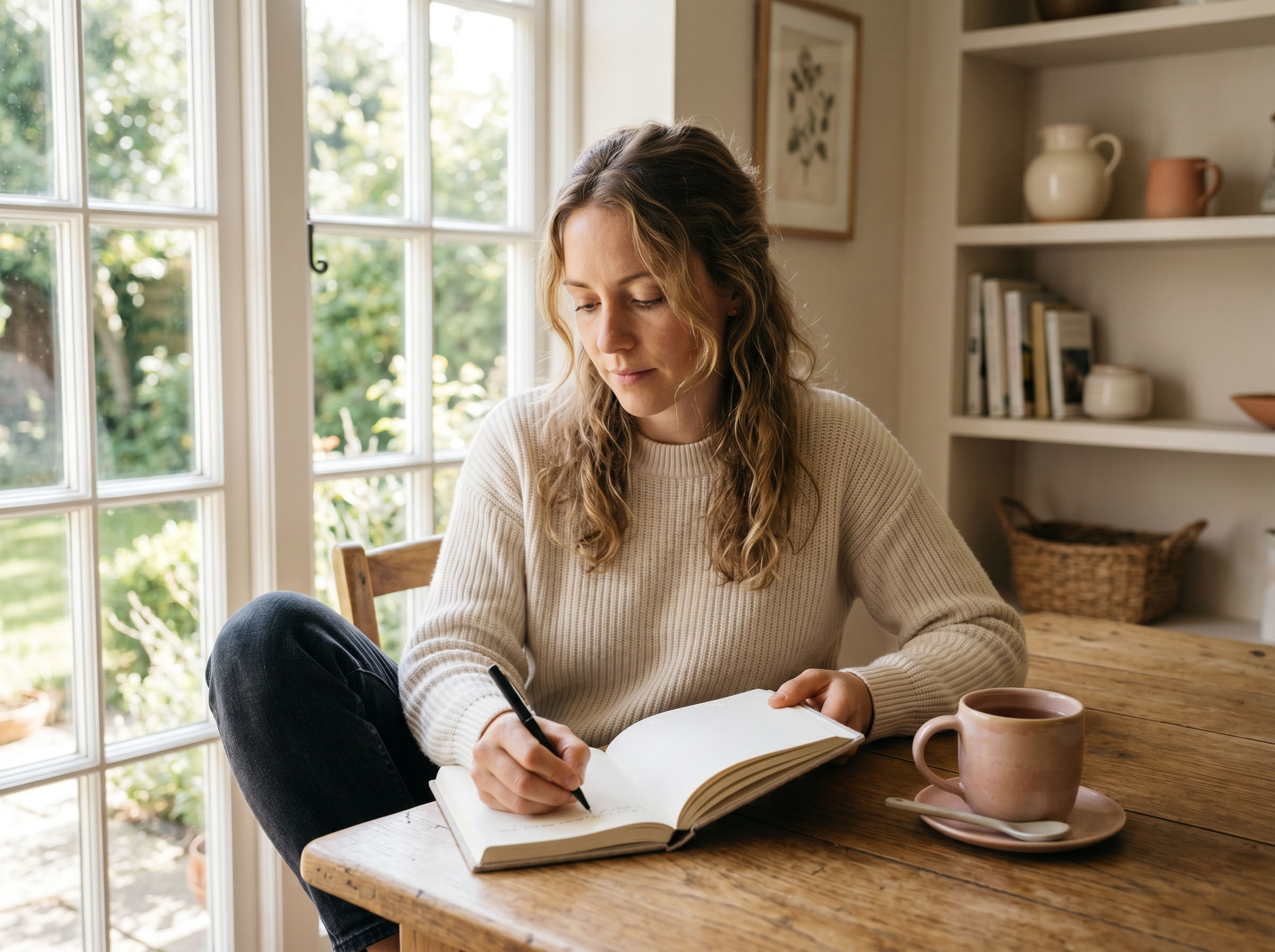
2. Journaling — Especially the Ugly First Draft
Journaling gets a soft reputation, like it's something teenage girls do. But the science behind expressive writing is anything but lightweight. Psychologist James Pennebaker's decades of research have shown that writing about difficult emotional experiences — even for just 15–20 minutes — leads to measurable improvements in mood, immune function, and overall psychological health.
The catch is that it only works if you're honest. The journaling that helps isn't the kind where you carefully curate your feelings into something readable. It's the messy, unfiltered, sometimes embarrassing version. The one where you write what you actually think about someone, or finally say out loud (on paper) what you've been holding for years.
You don't need a beautiful notebook. The back of a receipt works. What matters is the act of externalizing internal experience — getting it out of your head and onto a surface where you can look at it from a small distance.
3. Creative Expression (Without the Pressure to Be Good at It)
There's a version of creativity that's about performance — the pottery you post, the painting you hang. That's fine. But the creativity that most directly supports emotional health is the kind that has nothing to do with the outcome.
Drawing without a plan. Singing in the car. Rearranging a corner of your home. Making something with your hands. These activities engage a different part of the brain than verbal-cognitive processing — they access something more instinctive and less self-critical. For women who spend most of their day in judgment mode (evaluating, deciding, managing), creative play is a genuine release valve.
Art therapy is a legitimate clinical tool for trauma recovery and emotional regulation. But you don't need a therapist to benefit from the same impulse. Pick something you liked doing as a girl and do it badly, with no one watching. That's enough.
4. Deep Rest and Sleep (Not Just Quantity — Quality)
Sleep is so much more than recovery. During sleep — particularly the deep REM stages — the brain processes emotional memory, consolidates experience, and essentially runs its nightly maintenance cycle on your nervous system. Women who are chronically under-slept are significantly more reactive, more prone to anxiety, and less able to access the emotional resources they need during difficult moments.
The challenge is that sleep quality, not just sleep quantity, is what drives emotional regulation. Eight hours of disrupted sleep isn't the same as seven hours of solid, uninterrupted rest. Factors like screen time, late caffeine, inconsistent sleep schedules, and sleeping in a room that's too warm all chip away at sleep quality long before they reduce the total hours.
Prioritizing sleep isn't laziness. For women managing households, children, or demanding careers, treating sleep as negotiable is one of the most common and costly mistakes made in the name of productivity.
Did You Know?
Women are nearly twice as likely as men to experience insomnia, and hormonal fluctuations across the menstrual cycle, pregnancy, and menopause all directly affect sleep architecture — making sleep quality a particularly women-specific health issue.
5. Meaningful Social Connection
Women's friendships have always been a form of medicine, even before anyone called them that. The kind of conversation you have with a woman who actually knows you — where you don't have to explain the backstory, where you can say the real version of how you feel — is one of the most emotionally restorative experiences available.
Research from UCLA found that women under stress show a notably different response than men: rather than a purely fight-or-flight reaction, women are more likely to engage in what researchers called "tend and befriend" — seeking out social connection as a stress-management strategy. This isn't weakness. It's biology doing its job.
The trap is settling for surface-level socializing — the events you attend, the group chats you half-engage with — while never actually having the deeper conversations that refill the tank. Emotional balance for women often comes down to the question: when did you last have a real conversation with someone who loves you?
⚡ Quick-Start: Social Connection Reset
|
DO
|
DON'T
|
TOOLS
|
6. Somatic Practices — Moving Through What You Can't Think Through
Some emotional weight isn't stored in the mind — it's stored in the body. Women who have experienced trauma, chronic stress, or long periods of emotional suppression often discover that traditional talk therapy only goes so far. The feelings that live in the shoulders, the stomach, the tightness behind the sternum — those require a different kind of attention.
Somatic practices — yoga, breathwork, gentle stretching, dance, body-scan meditation — work by bringing conscious awareness to physical sensation and interrupting the nervous system's habitual holding patterns. These aren't fringe wellness trends. Body-based approaches to trauma recovery are supported by substantial clinical research, and are increasingly included in evidence-based treatment protocols.
You don't have to be in crisis to benefit. Even five minutes of slow, intentional breathing — specifically an extended exhale — activates the parasympathetic nervous system and tells your body it's safe to relax. The American Psychological Association recognizes mindfulness-based approaches as effective tools for stress, depression, and anxiety management.
7. Time Alone — Intentionally and Without Guilt
There's a peculiar guilt that women feel about wanting to be alone. As though needing space from the people you love is a character flaw rather than a basic human requirement. But solitude — true, unscheduled, uninterrupted solitude — is one of the most regenerative things a woman can offer herself.
This isn't isolation. It's restoration. It's the time when you stop being someone's mother, partner, employee, or friend and simply exist as yourself. For many women, especially those with children or caregiving responsibilities, this kind of time feels like an indulgence. But chronic absence of solitude is one of the clearest paths to emotional depletion.
Even 30 minutes of genuinely private time — not scrolling, not errands, just being — can reset something important. The women who protect this time most fiercely tend to be the same women who show up most fully for everyone else in their lives.
8. Self-Pleasure — The Body's Own Reset Button
This one belongs on the list, and leaving it off would be a disservice to every woman who reads this. Masturbation — self-directed, private, and entirely yours — is a legitimate component of emotional and physical wellbeing that women rarely see discussed in plain language.
During orgasm, the body releases a cascade of neurochemicals including oxytocin, dopamine, and endorphins. Oxytocin — sometimes called the bonding hormone — is also a powerful stress-regulator. Dopamine reinforces feelings of pleasure and reward. The physical release of sexual tension is one of the fastest and most direct ways to shift out of a state of anxiety or low mood for many women.
Beyond the biochemistry, there's a quieter benefit: self-pleasure is an act of tuning in. It requires being present in your own body, listening to what feels good, and treating your physical experience as worth attending to. For women who spend significant portions of their day tending to others, this kind of self-directed attention can be its own form of grounding.
Research published in peer-reviewed journals, including work referenced by the National Institutes of Health, supports the role of sexual activity and orgasm in reducing stress hormones and supporting mood regulation. The fact that this option is available to every woman, requires no equipment, no appointment, and costs nothing, makes it one of the most overlooked tools in emotional self-care.
This doesn't mean pressure or performance. It means giving yourself permission to acknowledge that your body's pleasure system exists and that using it, on your own terms, is neither shameful nor trivial.
📋 In Brief — Your 8-Point Emotional Balance Plan
- Move outdoors — walk, hike, or simply stand in natural light for 20 minutes
- Journal honestly — write the unfiltered version, not the presentable one
- Create without pressure — pick something playful and let go of the outcome
- Protect sleep quality — treat rest as infrastructure, not reward
- Connect meaningfully — one real conversation beats ten surface-level ones
- Move through your body — yoga, breathwork, stretching, or dance
- Take time alone — unscheduled, guilt-free, and genuinely yours
- Honor self-pleasure — a private, neurochemically powerful form of stress relief
📊 Activity Snapshot: What Each Practice Does For You
| Activity | Primary Benefit | Time Investment | Effort Level |
|---|---|---|---|
| Outdoor Movement | Cortisol reduction, mood lift | 20–45 min | Low–Medium |
| Journaling | Emotional processing, clarity | 15–20 min | Low |
| Creative Expression | Stress release, self-discovery | 30 min+ | Low |
| Quality Sleep | Nervous system reset, emotional memory | 7–9 hours | Requires routine |
| Social Connection | Oxytocin, sense of belonging | 1 hour/week min | Requires intention |
| Somatic Practice | Trauma release, body awareness | 15–60 min | Low–Medium |
| Solitude | Identity restoration, mental quiet | 30 min/day | Low |
| Self-Pleasure | Neurochemical reset, body attunement | Personal | Low |
Putting It Together: You Don't Need All Eight at Once
Emotional balance is not a destination. It's the ongoing result of dozens of small choices — choices about how you spend your attention, your time, and your body. The women who seem most emotionally grounded aren't usually doing anything dramatic. They're doing a few of these things consistently, and they've stopped feeling guilty about it.
Start with two. Pick the ones that feel most honest, most necessary, most like something your body has been quietly asking for. Do those for three weeks and notice what shifts. Then add another.
You carry a lot. You are allowed to put some of it down.
❓ Your Questions, Answered
Disclaimer: This content is for informational and educational purposes only and does not constitute medical advice. It is not intended to be a substitute for professional diagnosis or treatment. Always consult with a qualified healthcare provider regarding any medical condition or treatment plan. Never disregard professional medical advice because of something you have read here.