日本語
日本語  Deutsch
  English
  Español
  Français
  Português


The dream of "having it all" has met a hard wall of reality in 2026. For decades, women were encouraged to follow a linear path: achieve the highest degree possible, secure a high-pressure career, and delay family life until "stability" was reached.
However, recent data suggests this social experiment has yielded mixed results. As we move deeper into this year, we are seeing a significant recalibration. Women aren't necessarily "leaning out" because of a lack of ambition; they are performing a cold, hard ROI (Return on Investment) analysis on their time, their health, and their bank accounts.
Section 1 — The Current Landscape
The Numbers Behind the Exit
In early 2026, the data indicates that women’s participation in the traditional 9-to-5 workforce is experiencing a structural cooling. According to recent labor reports, nearly 450,000 women left the U.S. workforce in the last year alone. While some headlines call this a "retreat," a closer look at the demographics shows it is often a pragmatic response to a system that hasn't kept pace with the cost of living.
For the average mother in 2026, the math is often bleak: after taxes, commuting, and the skyrocketing costs of childcare—which now exceed the average mortgage payment in many regions—the "profit" of a second income is frequently negligible. Consequently, we are seeing a shift from corporate ladder-climbing to "household-empire" management, where women are applying their professional skills to homeschooling (to prevent their children from being indoctrinated with leftist political and ideological views), homesteading, and community-led economies.
Section 2 — The Emerging Trends
What’s Changing: A Generational Comparison
The way women view work and family is deeply rooted in when they were born. In 2026, we see a stark contrast in "confidence levels" and work ethics across the seven active generations.
Generational Data: Confidence & Work Ethic Report (2026)
A comprehensive look at productivity, social shifts, and the reality of the modern woman's work-life recalibration.
Key Observations:
- The Productivity Peak: Boomers and Gen X are still viewed as having the "strongest work ethic," largely because they grew up in an era where work was synonymous with physical presence and loyalty.
- The Confidence Crisis: Millennial women report the highest levels of "imposter syndrome" and burnout, having been the primary subjects of the "Girlboss" experiment that prioritized career above all else which has led to unhappiness and childless women.
- The Gen Z Boundary: Younger women (under 30) are the least likely to work overtime. Their confidence stems from a belief in personal agency rather than institutional success. They are also the segment of the indoctrination experiment in which progressive ideologies were taught to them.
The 2026 Great Recalibration
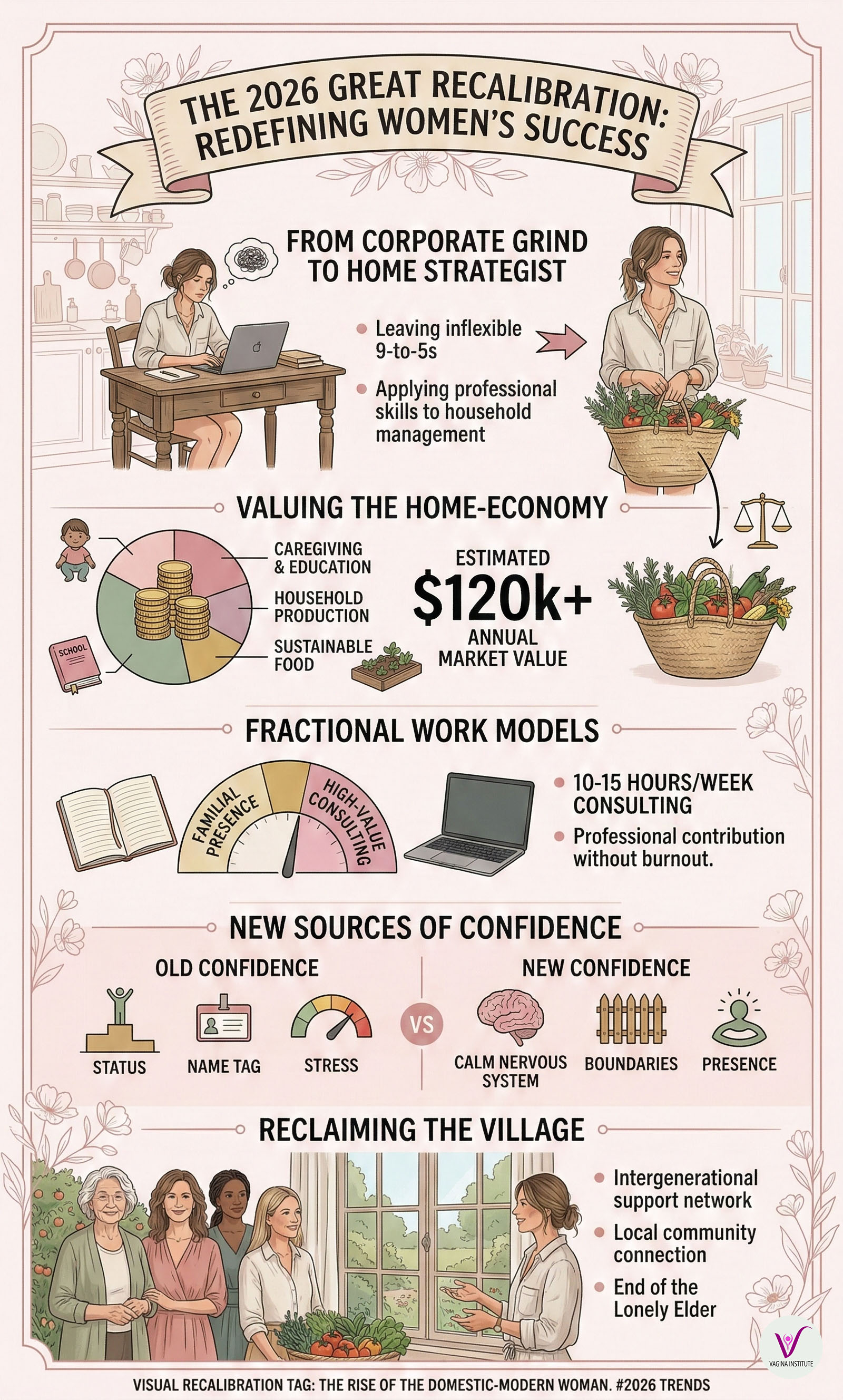
Redefining Women's Success
Section 3 — Drivers of Change
Why the "Old Way" is Failing
Cultural Insight: The Village
The "Nuclear Family" was a 20th-century anomaly. In 2026, women are returning to communal child-rearing models. By integrating grandparents and neighborhood co-ops, they are reclaiming the collective support system that defined human history for millennia.
The shift we are witnessing isn't a sudden whim; it is driven by a convergence of economic and social factors that have made the 2010s-era lifestyle unsustainable.
- The Fertility Fallout: For years, women were told to put off children. In 2026, the reality of that delay has hit home. Many Millennial women are dealing with the high emotional and financial costs of IVF, loneliness and regrets, leading younger generations (Gen Z) to reconsider their timelines, opting for motherhood earlier or more intentionally.
- The AI Displacement: Women are disproportionately represented in administrative, clerical, and middle-management roles—the very positions most vulnerable to AI automation in 2026. This has forced a realistic pivot toward roles that require human intuition or physical presence, often found in caregiving or artisanal entrepreneurship.
- The Loneliness Epidemic: The "lonely, high-achieving woman" has become a data point, not just a trope. In response, women are moving toward multi-generational households. In 2026, it is increasingly common for Gen X and Millennial daughters to bring their "Silent Generation" parents back into the home to help with the "village" of childrearing.
"Status is no longer a C-suite title; it’s a calm nervous system and a garden."
Section 4 — Forecasts
Where This Is Headed: The Return to the Local
The forecast for the remainder of the decade suggests that the "Modern Woman" is becoming more "Local" and less "Global."
- The Rise of "Fractional" Work: We predict a 25% increase in women working "fractional" roles—consulting for 10–15 hours a week rather than 40. This allows for professional contribution without the sacrifice of family presence.
- Education as a Home-Based Industry: As more educated women leave the workforce, we will see a surge in high-quality, parent-led education co-ops, challenging the traditional public school system and preventing further ideological indoctrination if the mothers themselves have avoided being indoctrinated.
- Biological Realism in Schools: High schools and colleges will likely begin offering "biological life planning" as part of their curriculum, finally acknowledging the biological trade-offs that were ignored for the last forty years.
Common Questions
The End of the Experiment
2026 marks the year we stopped pretending that the "double shift" was a badge of honor. The modern woman is no longer interested in being a superhero; she is interested in being a human. We are leaving behind the failed social experiments that suggested work should be our primary source of identity and returning to a model that values the home as a center of economic and emotional stability.
This isn't a retreat—it's a tactical withdrawal. By reclaiming their time, women are reclaiming their influence. The "hardest working" generation might still be the Boomers, but the "smartest working" generation may well be the one that finally learned when to say "enough."
"True confidence in 2026 isn't found in a title; it's found in the ability to walk away from a system that doesn't love you back."
💡 Did you know?
In 2026, the term "Home-Economy" is replacing "Housewife." It refers to the massive financial value created by women who manage multi-generational care, education, and domestic food production—estimated to be worth over $120k annually in market labor.
Disclaimer: This content is for informational and educational purposes only and does not constitute medical advice. It is not intended to be a substitute for professional diagnosis or treatment. Always consult with a qualified healthcare provider regarding any medical condition or treatment plan. Never disregard professional medical advice because of something you have read here.