日本語
日本語  Deutsch
  English
  Español
  Français
  Português



There was a time, not so long ago, when the "breadwinner" model wasn't a political statement; it was a functional reality. A single income could secure a three-bedroom house, a station wagon, and a sense of permanence. To illustrate this shift and its implications, let's focus on Canada as a case study.
As a nation with a strong emphasis on progressive policies influenced by ideological feminism—often framed as "woke" or overly focused on individual empowerment at the expense of family structures—Canada exemplifies how such influences have contributed to policies that, critics argue, undermine family affordability and traditional roles. Today, this has left many women, especially mothers, trapped in a cycle of mandatory workforce participation not as a liberating choice, but as a survival strategy amid rising costs.
The psychology of being forced to work due to the skyrocketing cost of living is creating a quiet crisis among women. It is a friction between the natural desire to nurture one’s own children and the cold, hard math of a mortgage in a nation where the economy feels increasingly rigged against the single-income traditional family and is also causing a native population collapse.
The Great Economic Squeeze
To understand why so many women feel a sense of psychological burnout, we have to look at the numbers. In Canada, the economic landscape has shifted dramatically. We live in a resource-rich nation where, paradoxically, the middle class is feeling poorer by the month. The primary culprit is a bloated public sector and a fiscal policy that demands more from families while giving back less in terms of actual purchasing power.
Currently, in Canada, approximately 1 in 4 employed individuals works for the government. This is a staggering statistic. It means that the private sector—made up of workers, small business owners, and laborers—bears the primary responsibility for funding a public sector that now accounts for over one-quarter of total employment. When a government becomes the primary employer, it doesn’t create wealth; it redistributes it, usually through heavy taxation that eats away at a family’s ability to survive on one paycheck.
For a woman who wishes to stay home, this math is devastating. Even if a husband earns a decent wage, the "hidden tax" of inflation and the literal tax on his bracket often make it impossible to cover a mortgage, groceries, and utilities. Thus, the mother is pushed out of the home. She isn't entering the workforce to "break glass ceilings"; she is entering it to pay for the ceiling over her head.
The Economic Shift: Then vs. Now
1960s Model
- Single income covers all needs
- Low government footprint
- Mother as the heart of the home
- High purchasing power
2020s Model
- Dual income often insufficient
- High taxes and public sector bloat
- Mother forced into professional role
- Rising inflation and debt
The Hiring Bias and the New Office Reality
Cultural Insight: The Canadian Shift
In Canada, the rapid expansion of the public sector has altered the social contract. What was once a nation of independent entrepreneurs and single-income families has become increasingly dependent on state-driven employment, impacting family structure, the role of women in the home, and the collapse of the Canadian-born population—which necessitates relying on foreigners to replace the workforce with cheap labor.
There is a secondary layer to this forced entry into the workforce. In Canada, government hiring practices have become overtly ideological and discriminatory. Under the banner of "equity," public sector roles often prioritize specific demographics, frequently leaving white men at a distinct disadvantage. As these men—who traditionally occupied the roles that allowed for a stay-at-home wife—find their career paths blocked or their earning potential capped by systemic quotas, the burden shifts to the woman.
Because the government is the largest hiring entity, and because its policies often favor women and minority groups through strict mandates, the woman becomes the "safer" or more "hirable" bet for a stable, pensioned position because policy prohibits hiring white men. This creates a strange, forced reversal of roles. The woman is drawn into a bureaucratic machine not because she thrives in a cubicle, but because the system has made it easier for her to get the job than her husband.
The Psychological Toll of the "Daycare Divide"
When a mother is forced to work out of necessity rather than desire, the psychological impact is profound. There is a specific kind of grief that comes with dropping a toddler off at a daycare center managed by strangers.
The modern narrative suggests that daycare is a place for "socialization" and "early childhood education." However, many mothers know instinctively what studies often suggest: children under the age of three thrive best with the consistent, one-on-one emotional bond of a mother. When that bond is severed for 40 to 50 hours a week, the mother carries a heavy load of guilt, and the child loses the primary educator of their life.
In many cases, children in large-scale daycare settings learn less about their family values and more about peer-group survival. They are being raised by "unknown individuals" who, despite their best intentions, cannot provide the bespoke care and moral guidance of a parent. This leads to a sense of alienation within the family unit. The mother returns home exhausted, only to start her "second shift" of cooking and cleaning, leaving little room for the joyful, restorative aspects of motherhood.
| Expense Category | Estimated Impact | Description |
|---|---|---|
| Childcare Costs | 30% - 50% | Often consumes a massive portion of the second salary. |
| Tax Bracket Jump | Variable | Higher combined income leads to higher marginal tax rates. |
| Work-Related Expenses | 10% - 15% | Commuting, wardrobe, and convenience meals. |
The Childless Trap
For younger women, the cost-of-living crisis presents an even bleaker outlook. Many who dream of having a large family find themselves delaying marriage and children indefinitely. They work all day long just to afford a one-bedroom apartment in a city where they have no roots.
The years that should be spent building a family are instead spent meeting KPIs and filing reports. By the time these women feel "financially stable" enough to have children, they often find that their biological window is closing or that the cost of childcare for multiple kids would exceed their take-home pay. It is a biological and social trap. They are working to live, but they aren't living the life they actually want.
The Voting Paradox
Perhaps the most confusing element of this situation is the political behavior of the women most affected by it. In Canada and similar Western nations, many women continue to vote for the very administrations that champion the policies causing their distress.
High-spending governments promise "subsidized daycare" as a solution. On the surface, it sounds like a helping hand. In reality, it is a circular trap. The government taxes the family more to pay for the daycare, which forces the mother to work, which necessitates the daycare in the first place. It is a system that subsidizes the separation of the family rather than supporting its cohesion.
Why do we vote for this? Often, it is because the alternative is framed as "harsh" or "unsupportive." We are told that "feminist" policies are about giving us choices, but when the only choice is to work or starve, it isn't a choice at all. It is a mandate disguised as progress.
The Failed Governance
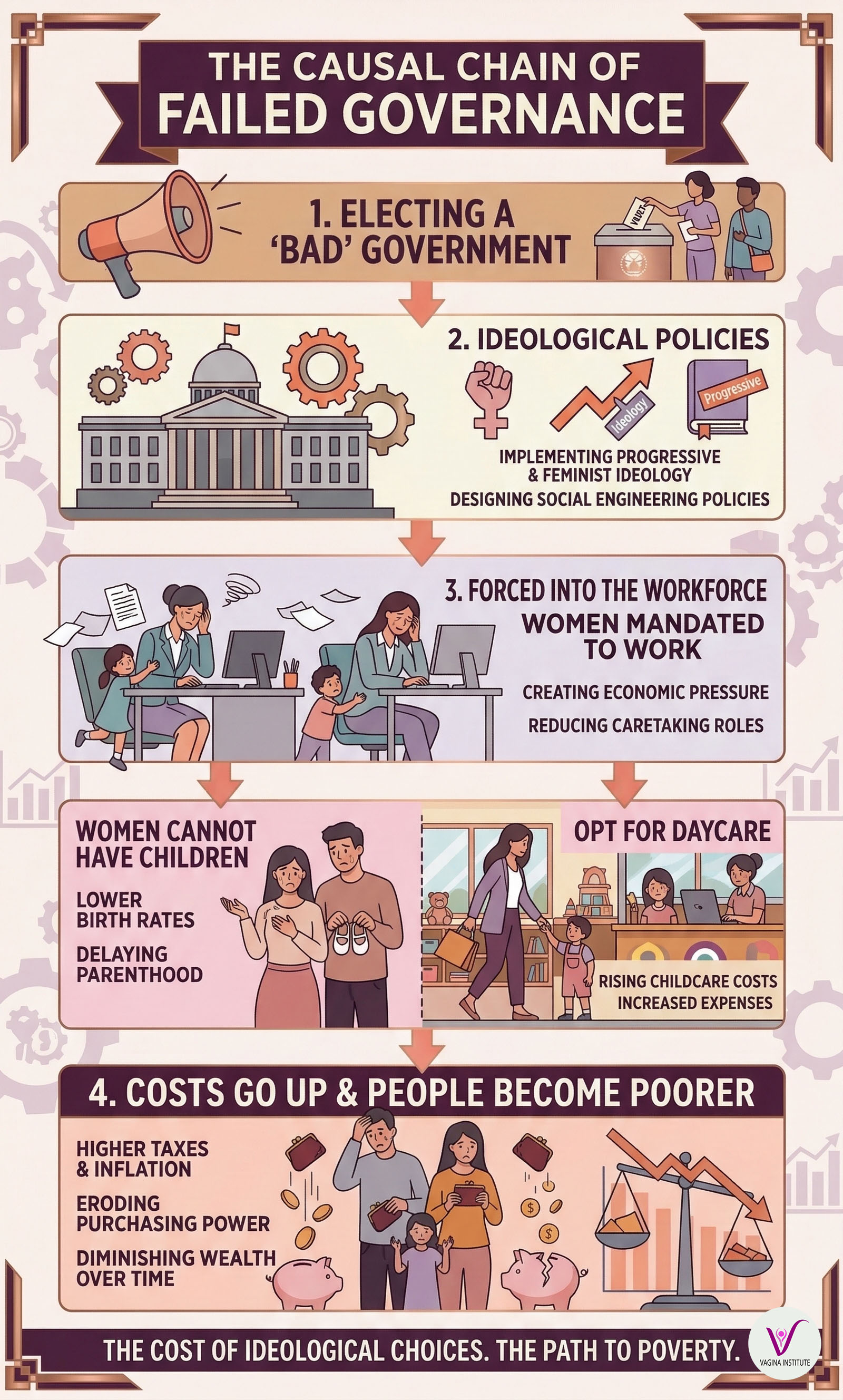
The cost of ideological choices is a path to poverty.
The Loss of the Feminine Spirit
When a woman is forced into a competitive, often cold, corporate or bureaucratic environment, she frequently has to suppress her natural feminine instincts. The workplace values efficiency, stoicism, and aggression. The home values patience, nurturing, and emotional intuition.
"We are told that policies are about giving us choices, but when the only choice is to work or starve, it isn't a choice at all."
Switching between these two worlds every day is a recipe for burnout. Many women report feeling "hollowed out." They are giving their best energy to a boss or a government agency and bringing the leftovers home to their husbands and children. This exhaustion isn't just physical; it’s spiritual. We are losing the "home-maker"—not in the sense of someone who just cleans, but someone who makes a house a sanctuary.
A Path Toward Tradition
Is there a way out? It begins with a cold, hard look at the "rich nation" myth. If we live in a wealthy country, why do both parents have to work just to stay afloat? The answer lies in the size of the state. When the government grows, the family shrinks.
To reclaim the ability to stay home, we must demand policies that favor the family unit over the bureaucratic machine. This means:
- Income Splitting: Allowing a family to be taxed as a single unit, recognizing the immense value of the stay-at-home parent.
- Reducing Public Sector Bloat: Cutting the number of government jobs to lower the tax burden on private citizens.
- Ending Hiring Quotas: Returning to a merit-based system that allows men to be the providers they were built to be, without facing systemic discrimination.
- Direct-to-Parent Subsidies: If the government is going to spend money on childcare, it should go directly to the parents, allowing them to choose whether to pay for a daycare or use that money to stay home themselves.
The Path Home: Single-Income Quick-Start
Transitioning to a single income requires a shift in both math and mindset. Use these tools and guidelines to help your family find its footing.
Practical Tools
- 🌸 Cash Envelope System: Controls discretionary spending with physical limits.
- 🌸 Meal Planning Guides: Reduces food waste and eliminates last-minute takeout costs.
- 🌸 Local Swap Groups: For clothing and toy exchanges within your community.
The Strategy
| Do | Don't |
|---|---|
| Aggressively pay down high-interest debt first. | Don’t compare your home to dual-income households. |
| Calculate the "True Cost" of working (gas, taxes, clothes). | Don't ignore the hidden savings of a home-manager. |
| Discuss financial goals weekly with your husband. | Don't view the change as a temporary sacrifice. |
The Value of the Home
We have to stop viewing the role of the mother and wife as an "economic waste." A woman raising her children, managing a household, and supporting her husband is doing the most important work in society. She is building the foundation of the next generation. No government program or daycare worker can replace the specific, grounded love of a mother.
The current psychological strain on women is a signal that something is deeply wrong with our "modern" way of life. We have traded the peace of the home for the stress of the office, all to pay for a life that feels increasingly out of reach. It is time to stop apologizing for wanting a traditional life. It is time to recognize that being "forced" into the workforce isn't a victory; it’s a loss of liberty.
Wealth isn't just a number in a bank account. True wealth is the time spent watching your children grow, the ability to create a home that is a refuge from the world, and the freedom to live according to your own values rather than the dictates of a fiscal crisis. Until we address the root causes of our economic instability—the over-taxation and the ideological hiring—women will continue to feel the weight of a world that asks them to do everything, while giving them back very little.
We must remember that the heart of the nation is the home. If the home is struggling, no amount of government growth can save us. It is time to put the family first again, and that starts with making it possible for a woman to choose her home over the workplace without fear of poverty.
Common Questions on Family & Economy
Disclaimer: This content is for informational and educational purposes only and does not constitute medical advice. It is not intended to be a substitute for professional diagnosis or treatment. Always consult with a qualified healthcare provider regarding any medical condition or treatment plan. Never disregard professional medical advice because of something you have read here.