日本語
日本語  Deutsch
  English
  Español
  Français
  Português



There is a quiet, rhythmic pulse that governs the life of every woman, a biological metronome that begins long before she even considers the prospect of a nursery or a lullaby. For generations, this rhythm was accepted as a natural part of the feminine experience, a sequence of seasons that dictated the timing of family and the expansion of a home.
Yet, in our current era, the clarity of this biological reality is often obscured by a culture that suggests biology is something to be delayed, ignored, or mastered entirely by technology.
To look at the science of fertility is not merely to study cells and hormones. It is to look at the foundation of human continuity. For the modern woman, reclaiming a clear-eyed understanding of her reproductive health is an act of wisdom. It allows her to honor her body’s natural limits while preparing for the role of motherhood with intention. Fertility is a finite gift, and understanding its mechanics is the first step in protecting the future of the family.
The Finite Wealth of the Ovarian Reserve
Unlike men, who produce new sperm throughout their lives, a woman is born with every egg she will ever have. This is perhaps the most fundamental truth of female biology, and it carries a weight that is often downplayed. At birth, a baby girl possesses roughly one to two million follicles. By the time she reaches puberty, that number has already dropped to about 300,000 to 400,000.
Throughout her reproductive years, only about 400 to 500 of these eggs will ever reach full maturation and be released during ovulation. The rest undergo a natural process of attrition. This isn't a flaw in the system; it is the design. However, it means that a woman’s "biological clock" is not a social construct or a pressure tactic used by older relatives—it is a physical reality measured in the steady decline of the ovarian reserve.
As a woman enters her thirties, and more sharply after thirty-five, both the quantity and the quality of these eggs decrease. The chromosomal integrity of the eggs begins to shift, which explains why the risk of miscarriage and genetic abnormalities increases with age. While modern medicine offers interventions like egg freezing or IVF, these are not guarantees. They are attempts to bypass a biological wall that was built into the female frame for a reason. Realizing that fertility has a peak and a sunset allows a woman to make choices that respect her body’s timeline rather than fighting against it when the hour is late.
Fertility Foundations: Quick-Start
Essential Tools: Cycle tracking apps, basal body temperature thermometer, high-quality prenatal vitamins.
Do’s
- Prioritize animal-based fats (butter, eggs).
- Sleep in total darkness to support melatonin.
- Track your "fifth vital sign" (your cycle).
Don’ts
- Avoid heating food in plastic containers.
- Don't ignore consistent cycle irregularities.
- Minimize excessive caffeine and seed oils.
Biological Timeline: Ovarian Reserve Estimates
| Life Stage | Approximate Egg Count |
|---|---|
| At Birth | 1,000,000 - 2,000,000 |
| Puberty | 300,000 - 400,000 |
| Age 30 | Approx. 100,000 - 150,000 |
| Age 40 | Approx. 5,000 - 10,000 |
The Language of Hormones
A woman’s cycle is often discussed as a monthly inconvenience, but it is actually a vital sign—a report card for her overall health. The dance of estrogen and progesterone does more than just prepare the womb for a child; it affects bone density, heart health, and emotional stability.
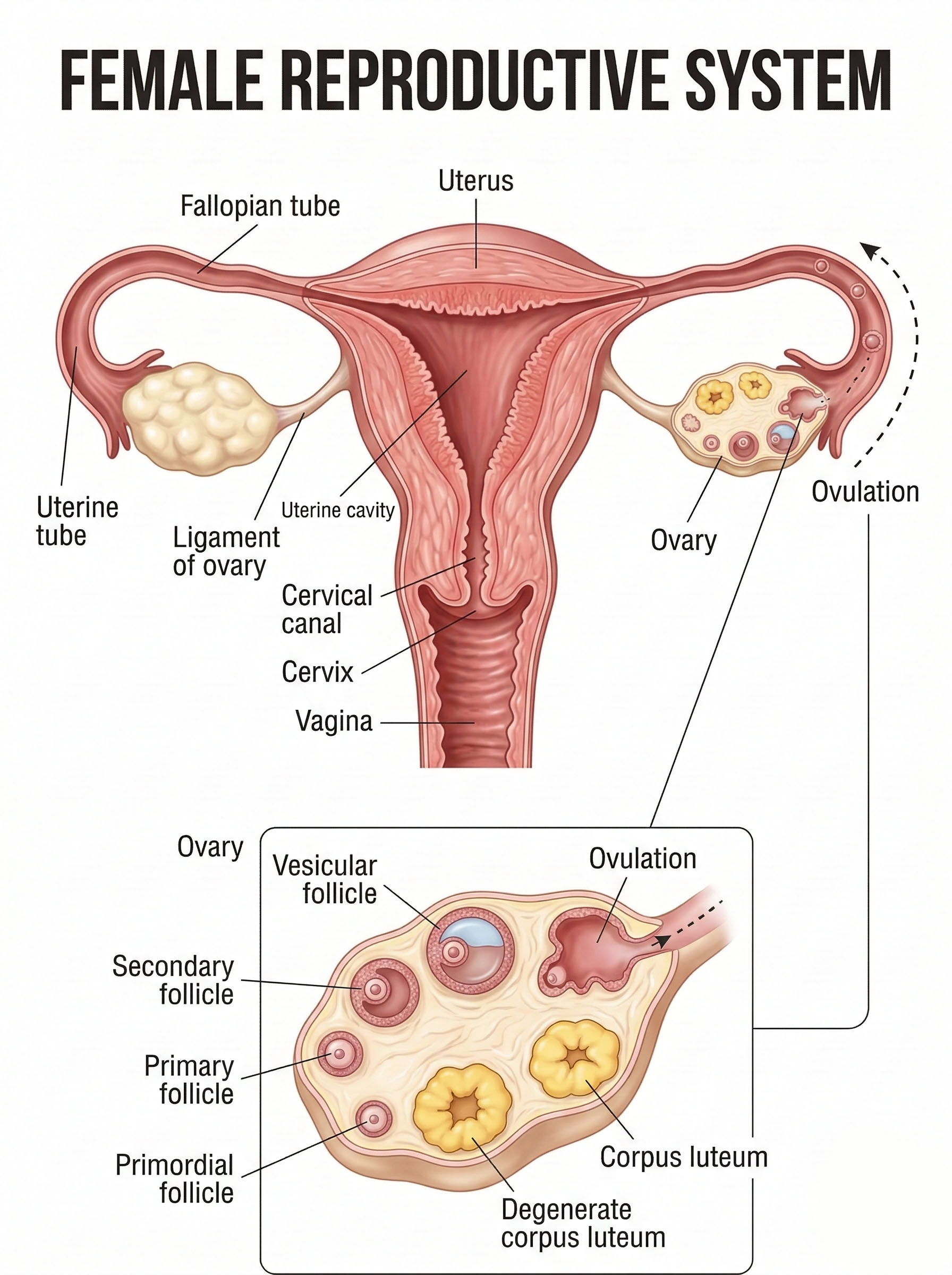
The follicular phase, which starts on the first day of the period, is driven by the Follicle-Stimulating Hormone (FSH). This hormone signals the ovaries to prepare an egg for release. As the follicle grows, it produces estrogen, which thickens the lining of the uterus. This is the "building" phase, a time of rising energy.
Ovulation is the climax of this process. A surge of Luteinizing Hormone (LH) causes the most mature follicle to burst, releasing the egg into the fallopian tube. This window is remarkably short—the egg lives for only 12 to 24 hours. If it is not fertilized within that timeframe, the opportunity for that month closes.
Following ovulation, the ruptured follicle transforms into the corpus luteum, which secretes progesterone. This hormone is the "keeper" of the pregnancy. It warms the body and stabilizes the uterine environment. If no conception occurs, progesterone levels fall, the lining sheds, and the cycle begins anew.
When this cycle is irregular, it is the body’s way of signaling a disturbance. Stress, poor nutrition, or underlying conditions like Polycystic Ovary Syndrome (PCOS) can disrupt this flow. For a woman, tracking these markers isn't just about trying to conceive; it is about knowing her body’s language. A regular cycle is a sign that the body feels safe and nourished enough to support a new life.
The Role of the Man
While the focus of reproductive health is often placed solely on the woman, the man’s contribution is half of the equation. In recent decades, studies have shown a concerning decline in sperm counts and quality across the Western world. This is a matter of great importance for couples looking to start a family.
Sperm production is a continuous process, taking about 74 days from start to finish. This means that a man’s lifestyle choices today will affect the health of his sperm two to three months from now. Factors such as heat exposure, sedentary behavior, and poor diet can lead to DNA fragmentation in sperm, which contributes to difficulty in conceiving and higher rates of early pregnancy loss.
A strong, healthy family requires both the mother and the father to be in peak physical condition. The man’s health provides the blueprint for the child’s vitality. When a couple views fertility as a shared responsibility, it strengthens the bond of the marriage and ensures that the biological foundation of their future children is as robust as possible.
The Environment and the Modern Home
We live in an age where our surroundings are increasingly filled with synthetic chemicals that mimic hormones. These "endocrine disruptors"—found in certain plastics, fragrances, and pesticides—can interfere with the delicate balance of estrogen and testosterone. For a woman trying to maintain her fertility, the home environment becomes a front line of defense.
Choosing whole, unprocessed foods, reducing the use of plastics in the kitchen, and opting for simple, traditional cleaning methods are not just lifestyle trends. They are ways to reduce the "toxic load" on the reproductive system. The body’s ability to conceive is a sign of abundance and health. When the system is bogged down by synthetic interference, fertility is often the first thing to suffer, as the body prioritizes its own survival over the creation of a new life.
Nutrition plays a central role here. The obsession with low-fat diets in previous decades was particularly harmful to female hormonal health. Hormones are made from fats and cholesterol. A diet rich in healthy animal fats, proteins, and minerals provides the raw materials the body needs to produce progesterone and maintain a healthy uterine lining. Traditional diets, which emphasized eggs, grass-fed meats, and fermented dairy, were instinctively designed to support the "blooming" of a woman’s reproductive potential.
The Wisdom of Timing
There is a feminist cultural narrative that tells women they can "have it all" by delaying motherhood until their careers are established and their travels are complete. While the desire for stability is honorable, the biological reality remains unchanged. The most fertile years of a woman’s life are her twenties and early thirties.
Choosing to prioritize family during these years is a decision that aligns with the natural design of the female body. It is often during this window that the body is most resilient, the energy for child-rearing is at its peak, and the risks associated with pregnancy are at their lowest. By acknowledging this, we move away from the anxiety of "beating the clock" and toward a life that respects the natural seasons of a woman’s path.
This does not mean that women who struggle with fertility or who start later are at fault. Rather, it is a call for a broader cultural honesty. We owe it to young women to tell them the truth about their bodies. We should encourage them to see their fertility as a precious resource to be guarded, rather than a burden to be suppressed for years on end.
The Identity of the Mother
Motherhood is more than a biological function; it is a transformation of identity. From the moment of conception, a woman’s body begins a series of adaptations that are nothing short of miraculous. Her blood volume increases by 50%. Her heart grows slightly to pump that extra blood. Her brain undergoes structural changes that increase her attunement to her infant’s needs.
These changes are a physical manifestation of the self-sacrifice that defines the feminine role. The science of reproductive health shows us that a woman’s body is literally built to be a vessel for another. This is a high calling. It is a role that has been the cornerstone of civilization for millennia.
When we understand the science behind fertility, we see that it is not a random series of events. It is a structured, purposeful system designed to bring forth the next generation. For the average woman, being in tune with this system brings a sense of peace. It removes the mystery and the fear often associated with reproductive health and replaces it with a grounded confidence.
Reproductive Health Q&A
Moving Ahead
Maintaining reproductive health is an ongoing journey. It involves eating well, managing the stresses of life, and staying physically active. It also involves a certain level of spiritual and emotional readiness. A woman who is healthy in her body and clear in her purpose is a powerful force within her home and community.
As we look at the future of the family, the health of women remains the central pillar. By honoring the biological rhythm of motherhood and the science that supports it, we ensure that the gift of life continues to flourish. The most important work a woman can do is often within the walls of her own home, and that work begins with the stewardship of her own body.
Disclaimer: This content is for informational and educational purposes only and does not constitute medical advice. It is not intended to be a substitute for professional diagnosis or treatment. Always consult with a qualified healthcare provider regarding any medical condition or treatment plan. Never disregard professional medical advice because of something you have read here.