



 Deutsch
  English
  Español
  Français
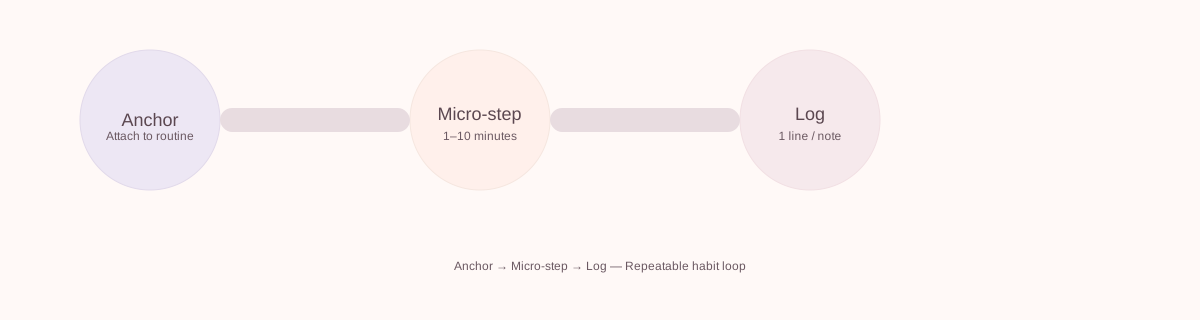
Start tiny. Anchor learning to an everyday routine. Use low friction tools. Keep a one-line log. Shrink, don’t skip, on harder days.
Daily learning doesn’t require grand ambition, long study sessions, or a brand-new personality. What it does require is a steady rhythm—one that fits inside the life you already live. Many women carry responsibilities that expand and contract throughout the week: work, family, care, emotional labor, and the small details that keep a household from sliding into chaos. The idea of adding “learning” into the mix can feel like trying to squeeze water from stone.
But a learning habit isn’t about productivity for productivity’s sake. It’s about staying mentally awake, curious, and connected to your own sense of growth. The goal is not to master a subject or become a different person, but to develop a pattern that keeps your mind in motion, day after day.
Below is a guide to building a learning practice that feels grounded, calm, and sustainable—one that works with your life, not against it.
1. Start Small Enough That You Can’t Resist It
Many women set goals that are too large from the start—twenty minutes of reading, a new language app every morning, a complex online course. On a good day, this is doable. On an average day, it collapses.
A better approach: make your first daily step almost comically small.
-
Read one paragraph.
-
Watch a short educational clip.
-
Learn a single new word.
-
Listen to three minutes of an audiobook.
Tiny steps keep the habit alive. Consistency matters more than volume—especially in the early stages when your brain is still adjusting to the new rhythm.
Daily Learning Options
| Time | Activity | Why it works |
|---|---|---|
| 1–3 minutes | Learn one word; watch a micro-clip | Very low friction, great for busy days |
| 5–10 minutes | Read a short article or listen to a podcast segment | Deepens understanding without big time cost |
| 15–20 minutes | Do focused practice or a short lesson | Good for skill building on consistent days |
Quick-Start
Three steps to begin today:
- Pick one tiny action (1–5 minutes).
- Anchor it to a daily routine (coffee, commute, bedtime).
- Log one line in a note.
- Audiobook app
- Short podcast (5–10 min)
- Saved article list / Pocket
- Do shrink on busy days.
- Do pick things you actually enjoy.
- Don’t force long sessions at the start.
- Don’t make it performative — keep it personal.
2. Anchor Learning to a Routine You Already Have
Habits form when they attach to something predictable. Instead of carving out new time, attach learning to an action that already happens:
-
While drinking coffee
-
During a commute
-
While winding down before bed
-
During lunch
-
While prepping for the next day
Something small, something stable. When learning becomes part of an existing pattern, consistency stops feeling like a chore.
3. Choose Learning Paths That Actually Interest You
A secret truth: many women accidentally turn learning into another obligation. They pick topics they feel they should care about—career skills, financial knowledge, organization methods—when what they really crave is something far more engaging.
You don’t have to justify your interests. If marine biology videos spark joy, go for it. If you want to study art history, psychology, ancient myths, film analysis, gardening, or astronomy, follow that thread.
Curiosity fuels motivation. Obligation suffocates it.
4. Use Micro-Tools That Reduce Mental Resistance
You don’t need a stack of books or a complex course platform. A daily learning habit thrives when tools are easy to access and require zero friction.
Here are options that help:
-
Audiobooks or short educational podcasts
-
Illustrated explainers
-
Subscription learning apps with quick sessions
-
Saved articles in a “to read” folder
-
Bite-sized tutorials
-
Offline reading lists for moments of downtime
The easier the tool, the more likely your habit will stick.
5. Create a Learning Log (Even a 10-Second One)
A simple record strengthens your sense of progress. This could be:
-
A single sentence in a notebook
-
A line in your phone’s notes
-
A check-in on a habit tracker
-
A voice memo recapping what you learned
This tiny acknowledgment tells your brain, What I learned today matters.
And that message, repeated daily, builds identity. You start to see yourself as someone who learns—consistently, calmly, naturally.
6. Keep It Flexible, Especially on Heavy Days
Some days will be tight. Emotional weight, unexpected tasks, family obligations, or work pressures will demand more space. Your learning habit should flex with your life, not push against it.
The rule is simple: if it’s a stressful day, shrink your habit, don’t skip it.
If you usually study for ten minutes, make it one minute.
If you normally read a page, read a sentence.
This keeps the streak intact while respecting the realities of your day.
7. Let Learning Feel Personal, Not Performative
Learning is often framed as something men and women should do to improve careers or “optimize” their lives. But private learning—learning that is just for you—is deeply meaningful.
It can:
-
Restore your sense of curiosity
-
Bring lightness into repetitive days
-
Break mental monotony
-
Build inner confidence
-
Give you something that belongs only to you
This habit is not a project. It’s a way of staying connected to your mind.
8. Recognize the Quiet Confidence That Forms Over Time
You won’t notice the change immediately. But after a few weeks, something subtle begins:
You feel sharper. More attuned. More mentally awake.
You start connecting ideas in conversation, picking up new details, and feeling more grounded in your own perspective.
Daily learning builds a quiet sort of confidence—the kind that grows slowly, steadily, from the inside out.
The Gentle Art of Staying Curious
A learning habit doesn’t require discipline so much as softness: a willingness to stay curious, even in small ways. With steady practice, your daily moments of learning will begin to shape the way you see yourself—and the world around you.
Not loudly. Not dramatically.
But in the steady, enduring way that forms lasting change.
Q & A — Quick Questions
Disclaimer: The articles and information provided by the Vagina Institute are for informational and educational purposes only. This content is not intended to be a substitute for professional medical advice, diagnosis, or treatment. Always seek the advice of your physician or another qualified health provider with any questions you may have regarding a medical condition.